Dyckman Farmhouse Museum
4881 Broadway | also 4901 Broadway | Inwood | built 1785
Open on the map11 entries

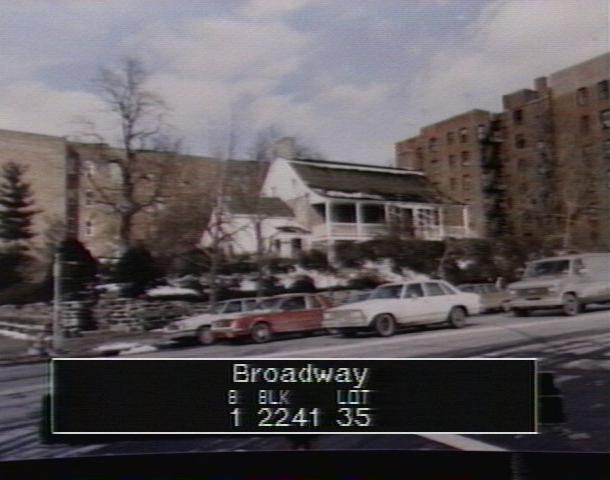
The city photographed every building for its tax records around 1940 and again in the 1980s. NYC Municipal Archives.
Written with AI from the source each entry cites, then fact-checked.
- 1776
Continental troops, then British and Hessians, camp on the Dyckman farm
Before the farmhouse stood, this hillside was part of a war zone. The Landmarks Commission report says the Continental Army, about ten thousand strong, occupied the 300-acre Dyckman farm after the Battle of Harlem Heights in September 1776. The ground later became the Hessian hut camp, roughly thirty-six small thatched wooden huts that served as the British outer defense until they left in 1783. When the British left, they also destroyed the orchards and the farmhouse of that era.
“The camp remained the outer point of defense for the British until 1783.”
- 1785
William Dyckman builds a new farmhouse after the Revolution
Around 1785 William Dyckman built this Dutch Colonial farmhouse of fieldstone, brick and clapboard with a gambrel roof, replacing an earlier family house near the Harlem River that was destroyed during the Revolutionary War. It anchored more than 250 acres of Dyckman farmland and is now Manhattan's only surviving 18th-century farmhouse.
Source: Wikipedia
- 1809
Jacobus Dyckman frees Francis Cudjoe, the one enslaved man known by full name
A manumission recorded on January 11, 1809 shows Jacobus Dyckman freeing a Black man named Francis Cudjoe, about forty years old, for a payment of one dollar. The farmhouse museum's research calls Cudjoe, born about 1769, the only enslaved person known by full name in Dyckman family history. He worked at the standing farmhouse property roughly a decade before a cook named Hannah, and the museum thinks their time here may have overlapped.
Source: dyckmanfarmhouse.org
- 1868
The Dyckman family sells the farmhouse, ending decades as a home
In 1868, the Dyckman family sells the Broadway farmhouse it built after the Revolution, and the property becomes a rental for several decades. By the early 20th century the house is in disrepair and in danger of demolition as development spreads through Inwood.
Source: Wikipedia
- 1915
The Dyckman sisters' restoration strips off an 1830s wing and refurnishes the house
Restoration began in the fall of 1915 under Bashford Dean and architect Alexander Welch, husbands of the two Dyckman sisters. They kept the features they believed oldest and tore down later additions, including a northern wing from the 1830s, then furnished the rooms with objects gathered from friends and family. The museum itself notes that the result leaned on the Colonial Revival's romantic view of colonial life; the farmhouse was open to visitors by July 1916.
Source: dyckmanfarmhouse.org
- 1916
Two Dyckman sisters buy back the farmhouse and give it to the city
The Dyckmans sold the house in 1868, and by the early 1900s it faced demolition. In 1915 sisters Mary Alice Dyckman Dean and Fannie Fredericka Dyckman Welch bought it back and had it restored under architect Alexander McMillan Welch. In 1916 they donated it to New York City as a museum of Dutch and colonial life, furnished with original Dyckman family pieces.
Source: Wikipedia
- 1916
Historian Reginald Pelham Bolton reconstructs a Hessian hut on the grounds
As part of the 1915-16 restoration, historian Reginald Pelham Bolton reconstructs a Hessian hut on the farmhouse grounds, based on Revolutionary War-era encampment sites he had excavated nearby. The reproduction hut joins the restored farmhouse and a period garden when the museum opens to the public in July 1916.
Source: dyckmanfarmhouse.org
- 1918
The city fires the farmhouse's first curators and hires friends of the parks commissioner
The museum's original curator, Charles F. Flitner, and a second employee, Martha Rush, had been chosen at the Dyckman family's request. In 1918 both were dismissed and replaced by Frederick and Margaret Hensler, friends of the city's park commissioner. Members of the public objected to the switch. Frederick Hensler ended up serving as curator for just two years.
Source: Wikipedia
- 1953
A passerby in 1953 takes the farmhouse for an antique shop
The farmhouse closed briefly in mid-1953 for repainting and refurbishment, and an entrance on the northeast side was sealed. That year the house was so little known that a passerby interviewed about it said he had assumed it was an antique shop. The New York Times, for its part, described the building as in excellent condition throughout the 1950s, and in the 1960s it opened six days a week without charging admission.
Source: Wikipedia
- 1967
The Dyckman House is named a national and city landmark
In 1967 the farmhouse was designated both a National Historic Landmark and a New York City landmark. A major restoration began in 2003, and the house reopened to the public in the fall of 2005.
Source: Wikipedia
- 2003
French and American volunteers help restore the farmhouse in a $1 million project
The house closed in 2003 for a major restoration that involved Preservation Volunteers, an exchange program in which French and American volunteers repair historic buildings in each other's countries. It reopened to the public two years later. The work, costing about $1 million, covered repainting, new mechanical systems and lighting, and repairs to the facade and interior, with the grounds restored in 2007.
Source: Wikipedia
Further reading
- Dyckman HouseWikipedia
Nearby
- Inwood Post Office90 Vermilyea Avenue | 2 entries
- Mount Washington Presbyterian Church84 Vermilyea Avenue | 3 entries
- Church of the Good Shepherd4967 Broadway | 5 entries
- The Eliza and Inwood Library4790 Broadway | 3 entries
- 67 Payson Avenue2 entries
- St. Jude Church3815 10th Avenue | 1 entry