Martin Bates, Jr. & Co. Building
489 Broome Street | SoHo | built 1874
Open on the map5 entries

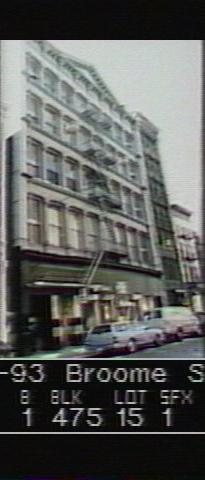
The city photographed every building for its tax records around 1940 and again in the 1980s. NYC Municipal Archives.
Written with AI from the source each entry cites, then fact-checked.
- 1874
A 20-year-old J. Morgan Slade completes a cast-iron fur warehouse in four months
Slade, who had opened his own office only after training under Edward H. Kendall, won the commission from silk merchant Martin Bates at age 20. Construction ran from August 1, 1873 to January 31, 1874 and cost $75,000. Slade picked cast iron for speed, since pre-cast sections could be bolted to the masonry frame, and kept the ornament plain, topping the columns with a simple egg-and-dart ring.
Source: Daytonian in Manhattan
- 1874
Martin Bates, Jr. & Co., a fur dealer with a large sealskin trade, moves in
Bates moved his own firm into the new building. The company traced its roots to 1834 in Boston, opened a New York office in 1845 and took the name Martin Bates, Jr. & Co. in 1853. It did a big sealskin business, sending several steamships to Alaska for skins, and also dealt in buffalo robes, deer, elk and beaver. The firm left for Greene Street in 1880.
Source: Daytonian in Manhattan
- 1875
Customs seizes a tenant's Broome Street premises over allegedly undervalued Paris dress trimmings
The New York Herald reported a stir at the Custom House over the seizure of trimming importer A. De Grieff & Co., a tenant here. Inspectors were posted at the building so nothing could leave. The firm had declared 95 cases from Paris at $14,000, but its senior partner admitted they were worth about $70,000, and blamed a discharged clerk for the accusations of fraud.
Source: Daytonian in Manhattan
- 1892
I. Modry & Co. employs 390 workers, mostly women and many of them minors, in a lace and ruffling shop here
By 1892 Ignatius Modry's firm, which made caps, laces and rufflings, was one of the two main tenants. It employed 390 people, only 15 of them men. More than half the operators were minors, and 50 were under sixteen. Another tenant, a lace-goods maker, had advertised in 1881 steady work for experienced operators at $7 to $12 a week.
Source: Daytonian in Manhattan
- 1971
The Fischbach art gallery occupies the building as SoHo's factories turn to galleries
By 1971 the Fischbach gallery had taken space in the former Bates building, and in 1972 the upper floors were converted to studios and offices, one per floor. Fischbach stayed into the mid-1970s, the Alessandro Gallery was here by 1976, and the Frank Marino Gallery was listed in 1981.
Source: Daytonian in Manhattan
Further reading
- The 1874 Martin Bates, Jr. & Co. Bldg - 489-493 Broome StreetDaytonian in Manhattan
Nearby
- 495 Broome Street1 entry
- 497 Broome Street2 entries
- 53 Wooster Street1 entry
- 55 Wooster Street1 entry
- 47 Wooster Street1 entry
- 357 West Broadway1 entry