E. V. Haughwout Building
490 Broadway | also 440 Broome Street | SoHo | built 1857
Open on the map10 entries

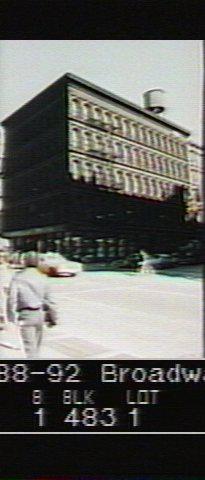
The city photographed every building for its tax records around 1940 and again in the 1980s. NYC Municipal Archives.
Written with AI from the source each entry cites, then fact-checked.
- 1857
Otis installs the world's first successful passenger elevator in Haughwout's store
Eder V. Haughwout sold imported cut glass, silverware, hand-painted china and chandeliers to wealthy customers, among them Mary Todd Lincoln, from this cast-iron building designed by John P. Gaynor. On March 23, 1857, the world's first successful passenger elevator went into service here. Designed by Elisha Graves Otis, it cost $300, rose at about two-thirds of a foot per second and was powered by a steam engine in the basement.
Source: Wikipedia
- 1857
Haughwout opens his new Broadway store for an evening of viewing before selling a single item
On the evening of March 23, 1857, E. V. Haughwout invited the public to tour his new emporium at Broadway and Broome Street, announcing that nothing would be sold so his staff could give visitors their full attention. Three floors of showrooms displayed cut glass, silverware, French porcelain, bronzes, clocks and chandeliers, while the fourth and fifth floors held the manufacturing departments. The firm was also the sole importer of De Venoge champagne when the store opened.
Source: Daytonian in Manhattan
- 1857
Architect John P. Gaynor designs a cast-iron emporium at Broadway and Broome
John P. Gaynor designs the five-story building for merchant Eder V. Haughwout, with an ornate facade cast entirely in iron by Daniel D. Badger's Architectural Iron Works. The technique, still new to New York, lets builders mass-produce elaborate Venetian-style details and bolt them together on site. The finished store rises 79 feet at the corner of Broadway and Broome Street.
Source: Wikipedia
- 1860
Haughwout's store presents three visiting Japanese ambassadors with services of cut glass
When three ambassadors from Japan visited New York in 1860, E. V. Haughwout & Co. gave each of them a service of cut table glass, a kind of glassware the New York Times called almost unknown in Japan. Every service came in a rosewood case with velvet lining and a silver shield engraved with the diplomat's name. The sets included goblets, decanters, rice dishes, finger bowls and saltcellars.
Source: Daytonian in Manhattan
- 1861
Mary Todd Lincoln orders the White House's new china from Haughwout's store
First Lady Mary Todd Lincoln turns to Eder V. Haughwout's Broadway emporium to supply and hand-paint a new state china service for the White House. The store's stock of imported cut glass, silverware and chandeliers has already drawn a wealthy clientele since it opened. The commission adds to Haughwout's standing as a major Manhattan purveyor of fine housewares.
Source: Wikipedia
- 1895
The Langdon estate sells the building as the carriage-trade stores move uptown
On March 5, 1895, the estate of Walter Langdon sold the former Haughwout store for about $375,000. Shops serving the carriage trade were already drifting uptown, and in the year before World War I the old showrooms were occupied by manufacturers, among them a rubber company, a maker of braids, and the silk and ribbon firm Cheney Brothers.
Source: Daytonian in Manhattan
- 1936
A supply company leases the entire building as its elegant past is forgotten
On September 24, 1936 the Broadway Manufacturers Supply Co. leased the entire building. By then the glamorous history of Haughwout's cast-iron palace had been largely forgotten. The middle of the twentieth century was a dark period for the surrounding cast-iron district, where ornate facades rusted under layers of grime and buildings that once held fine stores served as warehouses and small factories.
Source: Daytonian in Manhattan
- 1941
Robert Moses's Lower Manhattan Expressway, first proposed in 1941, puts the Haughwout Building at risk
Robert Moses's plan for an expressway across lower Manhattan dates to 1941, and the project was not finally beaten until 1969. The Haughwout Building was not directly in the planned path, but building the highway could have damaged it, and the building was considered in danger of being razed. The city designated it a landmark in 1965, while the expressway was still on the table.
Source: Wikipedia
- 1965
The city designates the Haughwout Building a landmark
The Landmarks Preservation Commission designated the building on November 23, 1965, protecting it from Robert Moses' proposed Lower Manhattan Expressway. Its cast-iron facades came from Daniel D. Badger's Architectural Iron Works. In a 1995 restoration supervised by Joseph Pell Lombardi, the columns were repainted their original color, a shade called Turkish drab.
Source: Wikipedia
- 1995
A restoration returns the cast-iron facade to its original color
Architect Joseph Pell Lombardi oversees a restoration that repaints the building's cast-iron columns and facade in their historic "Turkish drab" hue. The work comes decades after the building's 1965 city landmark designation and its 1973 listing on the National Register of Historic Places. It preserves one of Manhattan's earliest and best-known cast-iron commercial fronts.
Source: Wikipedia
Further reading
- E. V. Haughwout BuildingWikipedia
Nearby
- 494 Broadway1 entry
- 438 Broome Street2 entries
- 496 Broadway1 entry
- 500 Broadway1 entry
- 486 Broadway4 entries
- 484 Broadway1 entry