494 Broome Street (Zucker building)
492 Broome Street | also 494 Broome Street | SoHo | built 1892
Open on the map4 entries

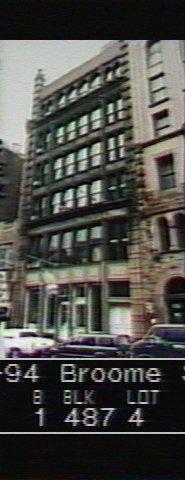
The city photographed every building for its tax records around 1940 and again in the 1980s. NYC Municipal Archives.
Written with AI from the source each entry cites, then fact-checked.
- 1891
Alfred Zucker completes a six-story Romanesque loft building with fern-like side piers
Real estate operator Henry Corn hired Zucker to replace the Ehrig brothers' saloon-supply business at No. 494. The architect produced a six-story structure with rusticated brownstone piers, cast-iron window frames and brick spandrels ornamented with fish-scale plates. Its most unusual feature is its tall side piers, carved with stems and buds like young fern fronds. It was finished by the end of 1891 beside his Fleitmann building.
Source: Daytonian in Manhattan
- 1892
A. G. Spalding & Bros. is already open here on New Year's Day 1892, pushing the bicycle craze
The sporting goods firm took the retail space and was already open on January 1, 1892. Its opening advertising pushed the newest bicycle models, as cycling swept the country. Later that year its ads listed gymnasium and athletic goods, baseball supplies, lawn tennis, lacrosse and boxing gloves.
Source: Daytonian in Manhattan
- 1909
A paper box factory fire rekindles overnight and causes $50,000 in damage
A blaze broke out on December 18, 1909 in Jacob Weinberg's paper box factory on the fourth floor, causing $2,000 in damage. The firefighters left, with piles of paper still lying about. The next morning an insurance watchman found the fire alive again, and the second blaze did about $50,000 in damage. Weinberg blamed careless work by the firemen.
Source: Daytonian in Manhattan
- 1912
The Italian Vineyard Company leases the whole building for a California wine showroom, then fights Prohibition
In October 1912 the California winery took the entire building as its New York showroom and warehouse. Its vineyards covered 4,000 acres. After a resolution calling for a constitutional amendment banning alcohol was introduced in Congress in December 1917, the company became a vocal lobbyist against Prohibition. The effort failed, and it left in 1919.
Source: Daytonian in Manhattan
Further reading
- Alfred Zucker's 1892 No. 494 Broome StreetDaytonian in Manhattan
Nearby
- 498 Broome Street1 entry
- 375 West Broadway1 entry
- 500 Broome Street5 entries
- Fleitmann & Co. Building484 Broome Street | 4 entries
- Lorillard tobacco factory379 West Broadway | 1 entry
- 55 Wooster Street1 entry