Mason Brothers Building
5 Mercer Street | also 7 Mercer Street | SoHo | built 1861
Open on the map5 entries

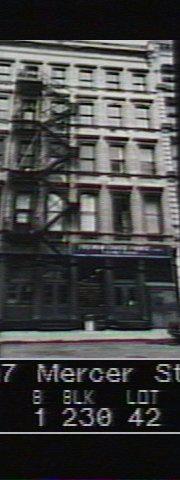
The city photographed every building for its tax records around 1940 and again in the 1980s. NYC Municipal Archives.
Written with AI from the source each entry cites, then fact-checked.
- 1860
Publishers Mason Brothers, who also print sheet music and a musical journal, move in
Mason Brothers moved in before the building was officially finished in 1861. The firm, run by brothers David G. and Lowell Mason Jr., issued academic books and sheet music, along with a biweekly, the New-York Musical Review and Gazette. A May 1860 advertisement listed its newest titles, including a three-volume Life of Andrew Jackson, The Life and Times of Philip Schuyler, and a history of Italy.
Source: Daytonian in Manhattan
- 1861
J. J. Phelps replaces two brick houses with a five-story cast-iron-fronted warehouse by John B. Snook
In 1859 J. J. Phelps bought 5 and 7 Mercer Street, two houses each 25 feet wide, tore them down and hired architect John B. Snook for a new building. The result was five stories of Italianate design over a cast-iron storefront from Daniel D. Badger's Architectural Iron Works, whose fluted columns once carried ornate Corinthian capitals. The building was officially completed in 1861, though its first tenants moved in earlier.
Source: Daytonian in Manhattan
- 1863
Mason & Hamlin sells cabinet organs for churches and homes from its Mercer Street warerooms
Mason & Hamlin, organized in 1854 by Henry Mason and Emmons Hamlin, shared the building with Mason Brothers and sold cabinet organs, also called parlor organs. A New York Times advertisement on May 11, 1863 invited clergymen to examine its new models at Nos. 5 and 7 Mercer Street, with one to twelve stops and prices from $70 upward, for small churches, chapels, Sunday schools and private houses.
Source: Daytonian in Manhattan
- 1886
The Base Sorting Plant handles khaki cloth scraps and turns its profits over to the government
John P. Lynch, who had emigrated from Ireland and ran a knit goods firm at 5 Mercer Street, was a fervent backer of Irish Home Rule, and The Sun reported on June 17, 1886 that he had sent a check for $200, the largest contribution to its Home Rule fund that day and his second, after an earlier gift of $100. His letter thanked the paper for its stand on liberty in general and Irish liberty in particular.
Source: Daytonian in Manhattan
- 1917
The Base Sorting Plant turns khaki cloth scraps over to the government for the war effort
On an upper floor was the Base Sorting Plant, which reused scrap materials from garment makers; Ira M. Kaplan, Nat Meyers and E. A. Stone ran it. By September 1917 it was handling the clippings left from cutting khaki cloth for military uniforms, and the old khaki rags from army camps. In late December trade papers reported that the business would operate in the government's interest for the war's duration, with the owners donating their services and handing over all profits.
Source: Daytonian in Manhattan
Further reading
- The 1861 Mason Brothers Building - 5-7 Mercer StreetDaytonian in Manhattan
Nearby
- 3 Mercer Street1 entry
- India Rubber Company Building9 Mercer Street | 2 entries
- 319 REAR-A Canal Street1 entry
- Isaac Lawrence row house321 Canal Street | 3 entries
- 1A Mercer Street1 entry
- 323 Canal Street4 entries