Castle Williams
501 Governors Island | also 501 Hay Road, 140 Carder Road | Governors Island | built 1900
Open on the map12 entries

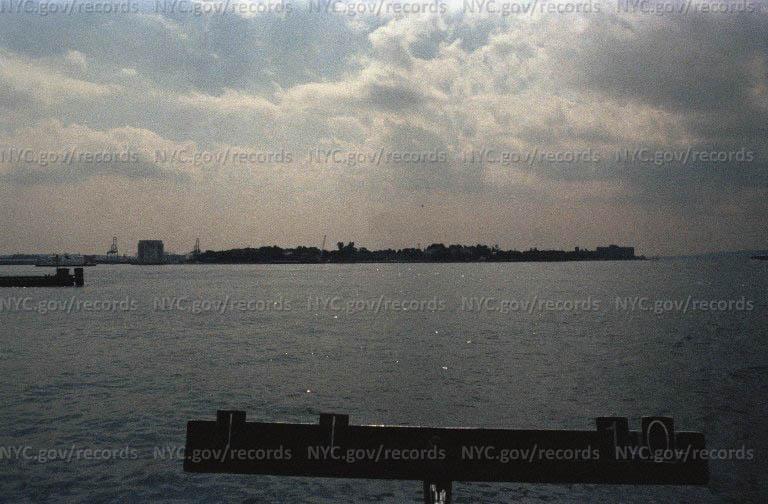
The city photographed every building for its tax records around 1940 and again in the 1980s. NYC Municipal Archives.
Written with AI from the source each entry cites, then fact-checked.
- 1810
The new Governors Island fort is named Castle Williams after its designer
The fort was built from 1807 to 1811 under Lieutenant Colonel Jonathan Williams, chief engineer of the Army Corps of Engineers. On November 24, 1810, Colonel Henry Burbeck ordered that it bear the name Castle Williams in his honor. Along with the island's other forts, it helped guard New York Harbor during the War of 1812.
Source: Wikipedia
- 1812
The Tower, nicknamed the Cheesebox, is one reason the British fleet never attacks New York
Finished in 1811 and ringed with more than a hundred cannon, the red sandstone fort was first called The Tower and nicknamed The Cheesebox for its round shape. The Landmarks Commission says it was among the reasons the British fleet never tried to attack New York in the War of 1812. It sat on the island's northwest point, guarding the channel to the city.
“…it was one of the reasons the British Fleet did not attempt an assault on New York during the War of 1812…”
- 1865
Castle Williams becomes a military prison after holding Confederates in the Civil War
During the Civil War the castle's casemates housed newly recruited Union soldiers and held Confederate enlisted prisoners and deserters. After 1865 it served as a military prison, a role that lasted until 1965, when the Army left the island. The Coast Guard later used it as a community center, and in 2003 it passed to the National Park Service.
Source: Wikipedia
- 1895
Castle Williams is designated a US Army prison, mainly for low-grade offenders
After the Civil War the Army upgraded the facilities at Castle Williams, installing insulation, heating and running water, and eventually electricity. In 1895 it was designated a US Army prison. According to the National Park Service it held mostly low-grade offenders with sentences under a year in a low-security setting.
Source: National Park Service
- 1901
Secretary of War Elihu Root overrules generals who wanted to demolish the castle
In 1901 Secretary of War Elihu Root committed to preserving Castle Williams and overruled Army leaders who wanted to tear down both it and Fort Jay. By 1903 it had been refitted into a state-of-the-art model prison facility. The National Park Service notes that Root worked hard to modernize the Army.
“In 1901, Secretary of War Elihu Root ... made a commitment to preserve the castle and overruled army leaders who wanted to demolish both it and Fort Jay.”
Source: National Park Service
- 1915
Castle Williams becomes a formal Army disciplinary barracks
Having served as a prison since the Civil War, the circular fort is designated the Atlantic Branch of the Fort Leavenworth Disciplinary Barracks in 1915, formalizing its role for military convicts. It is renamed again in 1921 as the Eastern Branch of the United States Disciplinary Barracks, a title it keeps for decades.
Source: Wikipedia
- 1947
Concrete walkways replace wooden catwalks and hide the castle's third-level stone arches
In 1947 extensive renovations replaced the castle's wooden catwalks with concrete-enclosed walkways. The new walkways hid the stone arches on the third level and gave the courtyard the industrial look it still has. The courtyard keeps that look today.
Source: National Park Service
- 1965
The Army closes its military prison inside Castle Williams
After nearly a century of holding military prisoners, Castle Williams stops operating as a disciplinary barracks in 1965 when the Army relocates its Governors Island headquarters. The Coast Guard takes over the island the following year and runs the old fort as a community center until the base itself closes in 1997.
Source: Wikipedia
- 1966
Coast Guard officials want to demolish the castle, then turn it into a youth community center
When the Coast Guard took over Governors Island in 1966, its officials in Washington wanted to demolish Castle Williams. Instead it was converted into a youth community center. It housed art studios, a photography lab, a woodworking shop, a museum, a nursery and rooms for Scouts and clubs. By the late 1970s the center had moved, and the fort became the base's grounds-keeping shop.
“Coast Guard officials in Washington, DC, who took control of Governors Island in 1966, wanted to demolish it.”
Source: National Park Service
- 1967
The city designates Castle Williams a landmark over the Coast Guard's objection that federal property is exempt
On September 19, 1967, the Landmarks Preservation Commission designated Castle Williams a landmark. The Coast Guard had written to question the proposal, saying federally owned property was not subject to local law. The commission acknowledged the jurisdictional question but said the city should state its deep concern that the building be preserved.
“…the Coast Guard questioned the proposal to designate the building, saying that Federally-owned property is not subject to regulation by local law…”
- 1996
Part of Castle Williams serves as a Halloween haunted house every year through 1996
Under the Coast Guard the castle served as a community center with arts and crafts classrooms, a ballet studio, Scout meeting rooms, a daycare room and a teen club. Later it became a warehouse and landscaping shop. The National Park Service says part of the castle served as a haunted house each Halloween through 1996.
“…for every Halloween through 1996, a portion of the castle was used as a haunted house…”
Source: National Park Service
- 2003
Castle Williams joins the new Governors Island National Monument
The National Park Service takes over Castle Williams and neighboring Fort Jay in 2003, folding both forts into the newly created Governors Island National Monument. The transfer ends nearly two centuries of military control and opens the fort toward public visitation and preservation.
Source: Wikipedia
Further reading
- Castle WilliamsWikipedia
Nearby
- Building 513513B Governors Island | 1 entry
- Building 513 (Enlisted Bachelors' Housing)513C Hay Road | 2 entries
- Fort Jay Nurses' Quarters114 Andes Road | 2 entries
- Building 513513A Hay Road | 1 entry
- Tampa Memorial Library251 Tampa Road | 1 entry
- Building 112112A Andes Road | 1 entry