510 Broadway
SoHo | built 1878
Open on the map6 entries

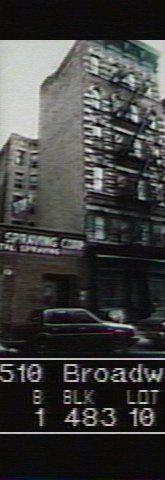
The city photographed every building for its tax records around 1940 and again in the 1980s. NYC Municipal Archives.
Written with AI from the source each entry cites, then fact-checked.
- 1841
An earlier house on the lot becomes a doctor's office by 1841
A house that belonged to Thomas F. Cornell in the 1830s stood at 510 Broadway before the present loft building. By 1841 it served as a medical office, and Dr. John H. Whittaker, who gave his address here in a newspaper advertisement the next year, practiced out of it through at least 1845. The Daytonian in Manhattan also finds a Dr. Granville Sharp Pattison sharing the house.
Source: Daytonian in Manhattan
- 1878
William Bloodgood designs a stone-fronted loft for the lot after years of lawsuits
Read more
Samuel and Abraham Wood bought 510 Broadway in 1866, but disputes over the building plans and four lawsuits over construction damage stalled their project. They leased the lot to Heymann & Sons, and architect William Bloodgood's building went up from July 3, 1878, with Freeman Bloodgood as builder. It has an iron storefront with stone piers above.
Source: Daytonian in Manhattan
- 1893
Cloakmakers Ketchum & Jonas hide assets in a set of false books
In November 1893, days before announcing bankruptcy, the cloakmakers Saul Ketchum and Julius Jonas prepared false books that made part of their assets vanish. Their honest bookkeeper, Charles J. Halfer, reported $10,000 hidden. Jonas was arrested in July 1894, and Ketchum gave himself up on July 23; the pair had earlier been hidden at their lawyer's house and then a clerk's home in Brooklyn.
Source: Daytonian in Manhattan
- 1897
Two employees of a window-shade firm are arrested for selling its stock
Hunninghaus & Lindemann, window-shade makers at 510 Broadway, lost more than $2,000 of goods in 1897. Stephen Hart, a shipping clerk, and Charles Wuest, an errand boy, were arrested on July 16 for grand larceny. They said two Lower East Side shopkeepers, Herman Rappaport and Max Fishman, had pushed them to steal the shades and bought them all.
Source: Daytonian in Manhattan
- 1922
A fire in a necktie factory leads to a manufacturer's arrest on suspicion of arson
On the night of March 18, 1922, fire broke out in the second-floor factory of tie maker Samuel Zuckerman. A fire investigator found that two separate blazes had been set ten feet apart and that the safe held paper and silk soaked in benzene. Zuckerman said he knew nothing about the benzene until shown a receipt for two gallons, and he was taken from his Brooklyn home in handcuffs.
Source: Daytonian in Manhattan
- 1976
The upper floors become living and working quarters for artists
The building filled with apparel and textile firms for decades, and at some point it lost its balcony railing. In 1976 its upper floors were converted to joint living and working quarters for artists. The cast-iron storefront has since been restored to its nineteenth-century look.
Source: Daytonian in Manhattan
Nearby
- 508 Broadway1 entry
- 506 Broadway1 entry
- 512-516 Broadway56 Crosby Street | 2 entries
- John Vogt & Co. Store (502-504 Broadway)502 Broadway | 6 entries
- 518 Broadway1 entry
- Arturo Di Modica's studio54 Crosby Street | 3 entries