510 Hudson Street
West Village | built 1827
Open on the map5 entries

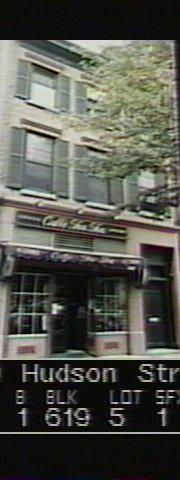
The city photographed every building for its tax records around 1940 and again in the 1980s. NYC Municipal Archives.
Written with AI from the source each entry cites, then fact-checked.
- 1827
No. 510 Hudson still looks much as Isaac Hatfield built it in 1827, apart from its ground floor
The Landmarks Preservation Commission used No. 510 to show what Isaac A. Hatfield's row of five town houses looked like when new. Apart from a remodeled first floor, the 1827 house keeps its Flemish-bond brickwork, its muntined double-hung windows, its roof dormers and a plain wood cornice. Hatfield was a carpenter and builder.
“The original appearance of this row of five town houses, built by Isaac A. Hatfield, carpenter and builder, is suggested by No. 510…”
- 1909
Teamsters at their Hudson Street headquarters raise a defense fund for their treasurer, accused of a stabbing
Around 1900 the ground floor of 510 Hudson housed International Teamsters' Union Local 449. In May 1909 its treasurer, Cornelius T. Shea, was arrested for stabbing Annie Walsh eleven times at 222 West 13th Street, and she was taken to St. Vincent's Hospital. On May 22 members met at the union rooms and began collecting money for his defense, with some excusing him as quick-tempered.
Source: Daytonian in Manhattan
- 1929
Developers buy 510 Hudson as the key parcel for an apartment-house assemblage that the Depression stalls
Brothers Harris and Maurice Mandelbaum, real estate operators, bought Nos. 502 through 508 Hudson and two Christopher Street lots by spring 1929. On June 6 they closed on No. 510, which the Times called the key to their holdings, giving them 112 feet on Hudson Street and 118 on Christopher. A resale to builders for an apartment house was pending, but the house and its twin at No. 512 survived, perhaps because of the Depression.
Source: Daytonian in Manhattan
- 1933
Architects Scacchetti & Siegel convert the vacant, decaying 510 Hudson into a store with apartments
By 1933 the house stood empty and neglected. The firm Scacchetti & Siegel of 1775 Broadway was hired to turn it into a ground-floor store with apartments above, and described the century-old structure as still sound despite its condition. The work left the building essentially unchanged above street level, which the blog's author notes was unusual for a decade with little regard for old houses.
Source: Daytonian in Manhattan
- 1970
510 Hudson becomes an art supply store and gallery, later Cafe Sha Sha and then Employees Only
A 1970 alteration turned the sidewalk level into an art supply store and commercial gallery, with a single apartment at the second floor and a duplex over it. In later decades the ground floor was Cafe Sha Sha, a neighborhood stop for pastries and coffee. It is now Employees Only, an American restaurant and cocktail bar, in a house that has kept its upper facade through nearly two centuries.
Source: Daytonian in Manhattan
Further reading
- The 1827 No. 510 Hudson StreetDaytonian in Manhattan
- Then & Now photos: 510 Hudson StreetVillage Preservation: Greenwich Village Then & Now
Nearby
- 252 West 10th Street4 entries
- Lucille Lortel Theatre121 Christopher Street | 16 entries
- 119 Christopher Street1 entry
- 509 Hudson Street5 entries
- 126 Christopher Street1 entry
- 117 Christopher Street1 entry