New York City Marble Cemetery
52 East 2nd Street | also 60 East 2nd Street | East Village
Open on the map6 entries

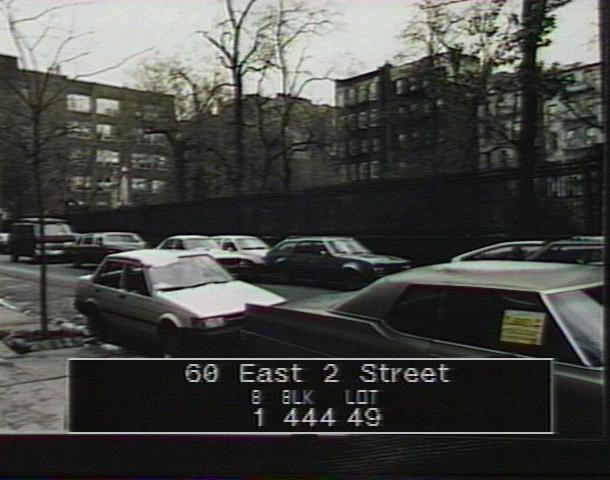
The city photographed every building for its tax records around 1940 and again in the 1980s. NYC Municipal Archives.
Written with AI from the source each entry cites, then fact-checked.
- 1831
Five organizers open a second marble-vault cemetery on land owned by Samuel Cowdrey
Evert Bancker, Samuel Whittemore, Henry Booraem, Garret Storm and Thomas Addis Emmet organize a nonsectarian burial ground on ground belonging to Samuel Cowdrey, who already owned a vault in the first Marble Cemetery a block away. Perkins Nichols builds the vaults of Tuckahoe marble, and the first are ready by summer. The company is incorporated on April 26, 1832, and by 1835 it has bought adjoining lots up to the present boundaries.
“…laid out on some land belonging to Samuel Cowdrey, a vault owner in the other cemetery. Once again Perkins Nichols contracted for the construction of the vaults…”
- 1831
Former president James Monroe dies and is among the first buried in the cemetery
Monroe moved to New York in 1830 after his wife's death to live with his son-in-law Samuel Gouverneur, who owned a vault here. When Monroe died on July 4, 1831, he became one of the cemetery's first burials, and the funeral was staged with military pageantry. The ceremony did a great deal to raise the young cemetery's standing.
- 1858
Monroe's remains leave the cemetery for Virginia with church bells tolling and flags at half-staff
In 1857 some Virginians living in New York plan a monument over Monroe's vault, which prompts the Virginia legislature to ask for his remains. The Gouverneur family agrees, and on July 2, 1858 the body goes to the Church of the Annunciation on Fourteenth Street, with bells tolling and ships in the harbor flying flags at half-staff. After lying in state for several days it travels by steamer, escorted by the Seventh Regiment, to Hollywood Cemetery in Richmond.
- 1890
The body of John Ericsson, inventor of the ironclad Monitor, is returned to Sweden
John Ericsson, the engineer who invented the ironclad Monitor, is buried in the Marble Cemetery until his body is returned to Sweden in 1890. The Landmarks Preservation Commission lists him among the nationally known figures interred here, along with the financier Moses Taylor and John Lloyd Stephens, a pioneer of Maya archaeology.
“John Ericsson, inventor of the ironclad Monitor, was also buried here before his body was returned to Sweden in 1890.”
- 1891
Alexander Maitland starts an endowment drive to keep the cemetery in a declining neighborhood
As the surrounding blocks decay, the trustees fear that new houses on the edges might push them off their land. In 1891 Alexander Maitland, a great-nephew of James Lenox, launches an effort to build an endowment, and his committee raises about $12,500. By 1934 the fund stands at $26,500.
“In 1891, Alexander Maitland, a grandnephew of James Lenox, started a movement to raise an endowment fund. He formed a committee, which collected about $12,500.”
- 1969
The Landmarks Preservation Commission designates the Marble Cemetery a city landmark
After a public hearing on December 13, 1966, where the cemetery's secretary spoke in favor, the commission designates the burial ground on March 4, 1969. It cites the cemetery as an early nonsectarian ground devoted entirely to family vaults, holding the vaults of distinguished families and once a president's grave. The grounds then held 256 vaults, visible from East 2nd Street through an iron fence with a gate.
“…the Landmarks Preservation Commission designates as a Landmark the New York City Marble Cemetery, 52-74 East 2nd Street…”
Further reading
- 60 East 2nd Street; 52-74 East 2nd Street; New York City Marble CemeteryVillage Preservation: East Village Building Blocks
Nearby
- Jacob Weeks House64 East 3rd Street | 3 entries
- 62 East 3rd Street3 entries
- 60 East 3rd Street1 entry
- 78 East 2nd Street3 entries
- 58 East 3rd Street1 entry
- 54 East 3rd Street1 entry