Stonehurst (Robert Colgate House)
5225 Sycamore Avenue | Riverdale | built 1930
Open on the map8 entries

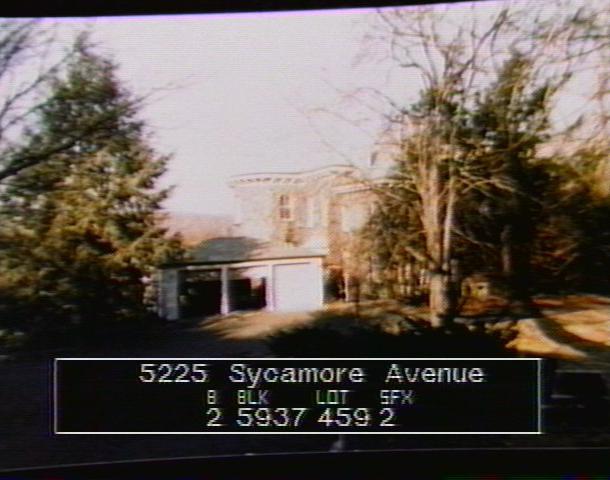
The city photographed every building for its tax records around 1940 and again in the 1980s. NYC Municipal Archives.
Written with AI from the source each entry cites, then fact-checked.
- 1858
Importer William Cromwell builds a stone Italianate villa above the Hudson
Put up around 1856-58 as William Cromwell's villa, by an architect who is not known, this Italianate house is the only stone villa in the Riverdale Historic District. Its hipped roof carries round-arched dormers, and a round bay with a curving metal porch looks west to the river. The south front has a shallower segmental bay, and the entrance sits under a gable on the north.
“The Cromwell villa (later known as Stonehurst, VII.1, a designated New York City landmark), at 5225 sycamore Avenue, dates from c. 1856-58 and is the only stone villa in the district.”
- 1859
William Cromwell moves into his new villa and dies the same year
Cromwell, a former partner in the syndicate that laid out Riverdale, sold his other house on Palisade (now Independence) Avenue in February 1859 and moved into the just-finished stone villa. He died that August.
- 1860
Robert Colgate of the soap-making family buys the estate and names it Stonehurst
In May 1860 Ann Cromwell sold the estate to Robert Colgate, a rich businessman from the soap-making family, for $52,500, and he gave it the name Stonehurst. It was then the biggest of the Riverdale estates now inside the historic district. Photographs from the 1860s show the villa and its terraced grounds, with urns on balustrades, looking much as they do now.
“…his widow sold the estate to Robert Colgate in May of 1860 for $52,500. Colgate named the estate "Stonehurst.”
- 1863
Riverdale Presbyterian Church is organized at a meeting in Colgate's house
The Riverdale Presbyterian Church came into being in 1863 at a gathering held in Robert Colgate's house. Until the congregation's James Renwick church was finished later that year, its Sunday school classes met here at Stonehurst.
- 1885
Merchant and museum founder Robert Colgate dies at Stonehurst
Robert Colgate (1812-1885), eldest son of the soap maker William Colgate, died on July 4, 1885, at Stonehurst. In 1845 he had founded a Brooklyn plant, the Atlantic White Lead and Linseed Oil Works, and his firm, R. Colgate & Co., grew into one of the country's biggest paint and linseed oil dealers. He was a founder and vice-president of the American Museum of Natural History.
- 1902
George W. Perkins buys Stonehurst, and his mother comes to live here
George W. Perkins bought the estate in 1902, a year before he took Wave Hill, as he kept buying land in Riverdale. Stonehurst became the home of his mother and of an aunt on his father's side. Perkins died in 1920, and in 1922 his widow, Evelina Ball Perkins, sold the estate to Spruille Braden.
“The estate was bought by George W. Perkins in 1902, the year before he acquired the Wave Hill Estate…”
- 1937
Evelina Perkins buys the estate back and carves it into lots
In 1937 Evelina Perkins repurchased Stonehurst from Braden and began dividing its eastern part into what became eleven lots and two private roads. That year she sold the villa itself to Wallace P. and Mary M. Zachary, who added a garage southeast of the house; John P. and Patricia Cunningham bought it in 1946.
“Evelina Perkins sold the Stonehurst house to Wallace P. and Mary M. Zachary in 1937 who added a garage (VII.6) to the southeast of the house.”
- 1970
Stonehurst becomes a landmark while former Attorney General Nicholas Katzenbach owns it
When the commission designated the house in 1970, its owner was Nicholas deB. Katzenbach, who had worked on desegregating Southern universities in President Kennedy's Justice Department and later served President Johnson as Attorney General and Undersecretary of State. The commission noted that the house had been linked with distinguished owners from the start and still was.
Further reading
- Robert Colgate HouseWikipedia
Nearby
- 5215 Sycamore Avenue3 entries
- 5245 Sycamore Avenue3 entries
- Alton L. Craft House5209 Sycamore Avenue | 2 entries
- 5243 Sycamore Avenue3 entries
- 5205 Sycamore Avenue3 entries
- 5249 Sycamore Avenue3 entries