Hauser & Wirth New York, 22nd Street
542 West 22nd Street | Chelsea | built 2020
Open on the map4 entries

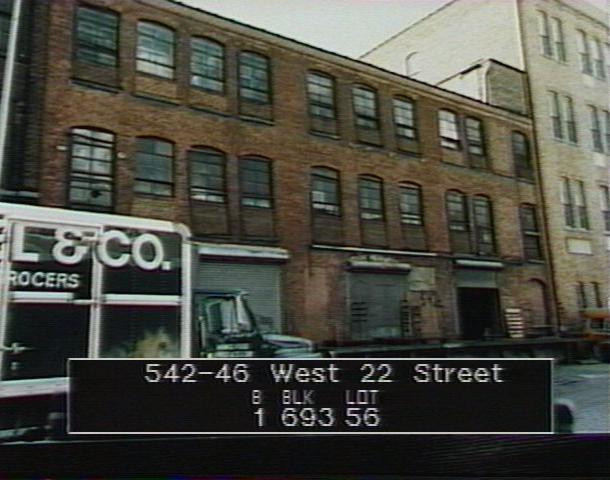
The city photographed every building for its tax records around 1940 and again in the 1980s. NYC Municipal Archives.
Written with AI from the source each entry cites, then fact-checked.
- 2020
Hauser & Wirth opens its first ground-up building, designed by Selldorf Architects
On October 6, 2020, Hauser & Wirth opened a five-story, 36,000-square-foot building at 542 West 22nd Street, next to its existing gallery in the former Dia Center for the Arts at 548. Designed by Selldorf Architects, it was the first building the gallery had put up from the ground for its own use. Glass doors on the ground and second floors fold away to open the facade, and a large roof hatch above the fifth-floor gallery lets works be craned in from the street.
Source: metalocus.es
- 2020
Artists for New York, a Covid-19 benefit show, is the first project in the new building
The first project presented in the building, Artists for New York, ran from October 6 to 22, 2020. Scores of contemporary artists donated works to raise money for 16 New York nonprofit visual arts organizations and charitable partners hurt by the COVID-19 pandemic. Solo shows by George Condo and Jack Whitten were due to follow in November.
Source: metalocus.es
- 2020
Four artists plan permanent works for the building's stairways and lifts
While the building was still under construction, Wallpaper reported that Martin Creed, Rashid Johnson, Mary Heilmann and Mark Bradford were planning permanent works for the stairways, lifts and other spaces. Annabelle Selldorf said she saw the architecture as part of the art experience. Rafael de Cárdenas outfitted the private offices and viewing rooms with interiors meant to recall domestic rooms.
Source: wallpaper.com
- 2023
Mark Bradford's first New York show since 2015 fills the entire 22nd Street building
Mark Bradford's exhibition You Don't Have to Tell Me Twice ran through July 28, 2023, and took over every floor of the building. It explored displacement and included paintings inspired by the history of European tapestry as well as large canvases that continued his work on the movement of African Americans north from the South known as the Great Migration, based on a chart of rail distances between American cities.
Source: artobserved.com
Further reading
- Hauser & WirthWikipedia
Nearby
- Dia Center for the Arts (former)548 West 22nd Street | 5 entries
- Dia Chelsea535 West 22nd Street | 6 entries
- 520 West 22nd Street3 entries
- Bayview Correctional Facility550 West 20th Street | 11 entries
- Church of the Guardian Angel193 10th Avenue | 4 entries
- 100 Eleventh Avenue100 11th Avenue | 2 entries