550 Madison Avenue (AT&T Building)
550 Madison Avenue | Midtown | built 1984
Open on the map14 entries

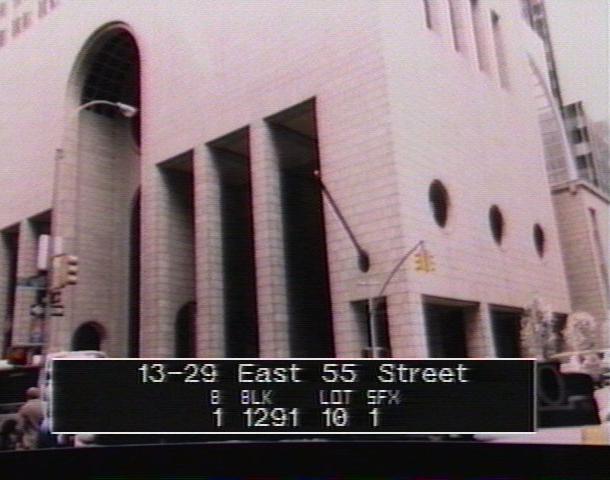
The city photographed every building for its tax records around 1940 and again in the 1980s. NYC Municipal Archives.
Written with AI from the source each entry cites, then fact-checked.
- 1977
AT&T picks Johnson/Burgee for its new headquarters after a questionnaire the architects ignored
AT&T sent a questionnaire to 25 firms, and Philip Johnson and John Burgee recalled paying it little attention. Stanley W. Smith visited eight firms and chose three finalists. After presentations on June 16, 1977, newspapers reported that Johnson/Burgee had won. Because AT&T required a minority firm as associate architect, Harry Simmons Jr.'s practice was picked from 28 firms considered and handled 20 percent of the architectural work, including public spaces and interiors.
- 1978
Critics start calling Johnson and Burgee's pediment-topped tower a Chippendale skyscraper
After the design was revealed in 1978, Paul Goldberger of the Times used the term Chippendale skyscraper, which he later credited to Museum of Modern Art curator Arthur Drexler. Drexler had said the pediment looked like the top of a grandfather's clock or a highboy. Goldberger also saw a likeness to Sant'Andrea in Mantua, while other writers compared the base to the Pazzi Chapel in Florence.
- 1979
Time puts Philip Johnson and a model of the AT&T tower on its cover
In January 1979 Time magazine put a photograph of Philip Johnson holding up a model of the tower on its cover, with an essay by Robert Hughes on American architects abandoning glass boxes. Hughes called the design peculiar rather than radical, an enormous pastiche, yet argued that backing from a leading corporation like AT&T gave postmodernism a degree of validity.
“Time magazine published a photo of Johnson raising a model of the tower on its cover in January 1979…”
- 1981
The steel frame of the AT&T tower tops out after workers excavated a pit 50 feet down into solid rock
Construction started in December 1978, with a pit dug 50 feet deep through solid rock. Steel began rising in March 1980 and workers started attaching the granite panels in September 1981. The frame was topped out in a ceremony on November 18, 1981. Engineer Leslie Robertson, who had worked on the World Trade Center, claimed that no steel frame had ever held up this much granite, so the hardware that mounted the panels had to be made much stronger.
- 1983
The Spirit of Communication statue is unveiled in the lobby and the building quietly opens
Staff began moving into the upper floors on July 29, 1983. On September 27 the 24-foot statue Spirit of Communication, by Evelyn Beatrice Longman, was unveiled in the lobby with Mayor Koch present; it had been moved from the roof of AT&T's old headquarters at 195 Broadway. Only three floors were occupied by year's end, and the breakup of the Bell System took effect on January 1, 1984.
- 1986
AT&T opens Infoquest, a free museum in the annex, after the city refuses a showroom plan
In 1984 AT&T wanted to drop its planned exhibition space in the annex and use the rooms as a commercial showroom instead, but the city refused the request. Infoquest Center, a free museum run by the company, debuted in May 1986. An AT&T executive had described the planned exhibit as a multimedia look at communications science and technology and at the nationwide communications network.
- 1987
The Quilted Giraffe, a four-star restaurant, moves into the AT&T Building
Chef Barry Wine and his wife Susan announced that their restaurant The Quilted Giraffe would leave a Second Avenue tenement and reopen on July 20, 1987, at 550 Madison Avenue, in the space of their casual cafe. The Times had awarded it four stars the previous October. Wine said he wanted to cook in the monumental AT&T Building, and he noted that the new kitchen ran at 70 degrees rather than the 105 degrees common in the old one.
Source: The New York Times
- 1991
Sony leases the whole tower, and AT&T's forfeited tax breaks go to the City University
In July 1991 Sony signed a 20-year lease for the entire building, with an option to buy it, after AT&T had shrunk and wanted to leave. AT&T gave back $14.5 million in tax abatements, the amount forgiven since 1987, and the money helped fund the financially strained City University of New York for 1991-92. AT&T moved its headquarters downtown and removed the Spirit of Communication statue. John Burgee remarked that the era of corporate image buildings seemed over.
“AT&T also forfeited $14.5 million of tax abatements to the city government ... fund programs at the financially distressed City University…”
Source: Wikipedia
- 1994
The City Planning Commission approves Sony's giant atrium video screen by 7 to 3
On April 20, 1994, seven members of the City Planning Commission voted for Sony's latest changes to the former AT&T atrium, including an 11-by-20-foot high-definition screen to promote its Wonder exhibit. Three opposed, and chairman Joseph B. Rose abstained, though he had said the space felt a lot like a Sony lobby. Community Board 5 had urged rejection by 23 to 14, and Borough President Ruth Messinger, who backed most of the changes, still worried the overall effect was overly commercial.
Source: The New York Times
- 1994
Sony Wonder opens in the annex after Sony converts the base into shops
Sony took over the building under a lease signed in July 1991, and a 1992 to 1994 renovation turned the open arcades into shops and the annex into the Sony Wonder technology museum, which opened that May. Dorothea Rockburne painted two fresco murals for the sky lobby. The Sony Wonder Technology Lab closed for good in January 2016, when Sony began moving out.
Source: Wikipedia
- 2010
Ice falling after a blizzard smashes the atrium's glass roof and injures several people
After a blizzard in February 2010, a mass of ice that had built up on an upper floor of 550 Madison Avenue broke loose and shattered the glass ceiling of the atrium below, hurting several people who were inside. The space, called Sony Plaza, had been enclosed and filled with shops during Sony's renovation of the former AT&T building between 1992 and 1994.
Source: Wikipedia
- 2015
Developers offer a $150 million three-story penthouse in a planned condominium conversion
In February 2015 the Chetrit Group filed a condominium offering for 96 residences with a combined price of $1.8 billion, as part of a plan to turn the tower into apartments and a hotel. It included a three-story penthouse at $150 million, then billed as Manhattan's most expensive home. Artist Dorothea Rockburne worried about her sky-lobby frescoes. The plan was dropped, and in 2016 Chetrit sold the building to Olayan Group and Chelsfield for $1.4 billion.
Source: Wikipedia
- 2018
Preservationists object as work begins in the lobby after the commission says the interior is not landmark material
The Landmarks Preservation Commission had decided that the lobby did not merit interior landmark status, citing the removal of the Golden Boy statue, changes to the lobby and its weakened tie to the base. Preservationists, including filmmaker Nathan Eddy and Docomomo US director Liz Waytkus, objected, and complained that renovation work had started in the lobby before the exterior was designated. The 16-ton statue, which had stopped in New Jersey in the 1990s, now stands at AT&T's Dallas headquarters.
Source: The New York Times
- 2018
The Landmarks Preservation Commission designates the AT&T Corporate Headquarters Building after a hearing
The commission calendared the building in November 2017 and held a hearing on June 19, 2018, where thirty-one people spoke in favor, among them representatives of the owner, Council Member Keith Powers, Community Board 5, DOCOMOMO US and the Municipal Art Society. Twenty of the speakers said designation should leave room to redesign the public spaces. The designation report is dated July 31, 2018.
Further reading
- 550 Madison AvenueWikipedia
Nearby
- IBM Building590 Madison Avenue | 12 entries
- Trump Tower721 5th Avenue | 18 entries
- St. Regis New York2 East 55th Street | 12 entries
- 19 East 54th Street4 entries
- Tiffany & Co. flagship store727 5th Avenue | 7 entries
- Aeolian Building689 5th Avenue | 4 entries