First Battery Armory
56 West 66th Street | Lincoln Square | built 1903
Open on the map13 entries

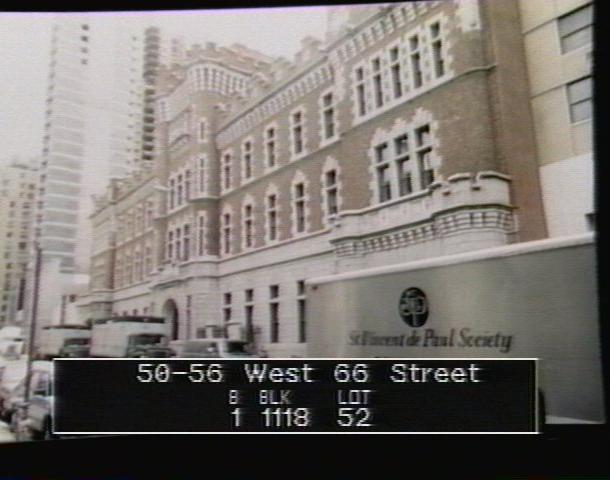
The city photographed every building for its tax records around 1940 and again in the 1980s. NYC Municipal Archives.
Written with AI from the source each entry cites, then fact-checked.
- 1901
The armory's castle-style tower carries the battery's 1901 insignia and motto
The armory's facade imitates a medieval castle, with a central tower, turreted end pavilions, loopholes, a machicolated cornice and a crenellated parapet. High on the tower, the First Battery's insignia is carved in relief: a shield dated 1901, the letters N.G.N.Y., the motto Semper Paratus, and muzzle-loading cannons tended by helmeted militiamen, one of them on horseback.
- 1904
A Brooklyn woman accepts a challenge to ride a bucking bronco in the armory's riding ring
On February 25, 1904, The Evening World reported that Victoria Jarvis, a young woman from Brooklyn, had accepted a challenge to ride a bucking bronco at the new armory, just three weeks after the First Battery moved in. The horse was said to have come lately from the West and to have thrown many good riders. Jarvis told reporters she expected no trouble because she was used to horses.
Source: Daytonian in Manhattan
- 1904
The First Battery Armory opens for a German-American militia unit
The First Battery of the New York National Guard, a German-American unit organized in 1867, opens its own armory at 56 West 66th Street on February 3, 1904. Architects Horgan & Slattery design the building as a medieval fortress with crenellations, turrets and loopholes, on land bought in 1900 for $115,681.
Source: Daytonian in Manhattan
- 1906
First Battery commander Louis Wendel is arrested for graft
Captain Louis Wendel, who has commanded the First Battery since 1881, is arrested on December 26, 1906, on graft charges. The scandal nearly leads to the unit's disbandment, but Adjutant General Nelson H. Henry intervenes to keep it intact.
Source: Daytonian in Manhattan
- 1907
Major John F. O'Ryan takes command of the First Battery after Captain Wendel is removed
Captain Louis Wendel was removed on May 10, 1907, on charges of bribery, graft and grand larceny, and Major John F. O'Ryan of the Second Battery took command and reorganized the unit. O'Ryan, a West Point graduate who became the city's Chief Engineer, later became major general of the state's National Guard forces. Governor Dix fired him, and Governor Sulzer reinstated him a few days later.
“Captain Wendel was removed from office on May 10, 1907, for bribery, graft, and grand larceny, and was succeeded by Major John F. O'Ryan…”
- 1919
Wrestling and boxing shows for recruiting and the Red Cross begin filling the armory
In November 1919 Major J. Franklin Dunseith, who commanded the First Field Hospital then based at the armory, named Billy Roche to run a big wrestling show as part of a recruiting drive. Another card that month, pitting Paddy Burns against Bushy Graham, both Army veterans, was a benefit for the American Red Cross. Daytonian in Manhattan says boxing and wrestling stayed the building's best-known events well into the Depression.
Source: Daytonian in Manhattan
- 1922
A boxer fractures his skull in a bout at the armory
After World War I the First Battery's soldiers are gone from the armory, and its drill hall becomes best known as a boxing and wrestling venue. On November 3, 1922, lightweight boxer Albert Press is knocked unconscious in a bout there and is found to have a fractured skull.
Source: Daytonian in Manhattan
- 1949
A tropical bird and canary show opens in the old artillery armory
On December 3, 1949, the armory staged an Open Exhibition of Colorful Tropical Birds and Canary Types. The building had been put up in 1903 for an artillery battery, with a drill room, riding ring and rifle ranges, but by this time military activity inside it was nearly nonexistent. The armory would be decommissioned in 1976.
Source: Daytonian in Manhattan
- 1976
A private club puts tennis courts in the drill room, then the city sells the armory to ABC
After the 102nd Medical Battalion left in January 1976, the armory was rented to a private club, which put tennis courts in the drill room. Later that year the city's Board of Estimate repurchased the building from the state for a single dollar and offered it at public auction. Capital Cities/ABC bought it in 1976.
- 1977
ABC converts the former armory into a television studio
After the state decommissions the armory, the American Broadcasting Company buys it at auction for $800,000 in 1976. ABC begins converting it in 1977 and finishes in January 1978, using it as a production studio for daytime shows including the soap opera One Life to Live. The studio is demolished in 2012 and the space becomes offices, later occupied by ESPN.
Source: Wikipedia
- 1989
The city designates the First Battery Armory a landmark with its owner's support
The Landmarks Preservation Commission designated the armory a landmark on August 1, 1989. At the July 12, 1988 hearing, 17 witnesses, among them the owner's representatives, supported designation and one took no position. The report describes it as one of the few surviving examples of a building type largely developed in New York City, and the seventh of ten armories built by the city's Armory Board.
- 2009
One Life to Live is announced to move out of its studio in the armory
On August 4, 2009, it was announced that the ABC soap opera One Life to Live, taped at ABC Studio 17 at 56 West 66th Street, would move in early 2010 to Studio 23 at 320 West 66th Street. That studio had become available because sister serial All My Children was relocating its production to Los Angeles.
“…would move from ABC Studio 17 at 56 West 66th Street to Studio 23 at 320 West 66th Street, Manhattan in early 2010…”
Source: Wikipedia
- 2025
Hebrew Union College announces plans to buy the armory from Disney
In February 2025 Hebrew Union College - Jewish Institute of Religion announced plans to buy and occupy the armory after selling its Greenwich Village building to New York University, a sale finalized that month. In July the college hired Beyer Blinder Belle to renovate the armory with classrooms, a library, and spaces for gathering and prayer.
Source: Wikipedia
Further reading
- First Battery ArmoryWikipedia
- The 1904 First Battery Armory -- No. 56 West 66th St.Daytonian in Manhattan
Nearby
- 50 West 66th Street10 entries
- Manhattan New York Temple (2 Lincoln Square)125 Columbus Avenue | 8 entries
- Holy Trinity Lutheran Church3 West 65th Street | 4 entries
- 67th Street Studios27 West 67th Street | 4 entries
- 55 Central Park West11 entries
- York Preparatory School40 West 68th Street | 4 entries