569 Bloomingdale Road Cottage
569 Bloomingdale Road | also 565 Bloomingdale Road | Woodrow | built 1898
Open on the map5 entries

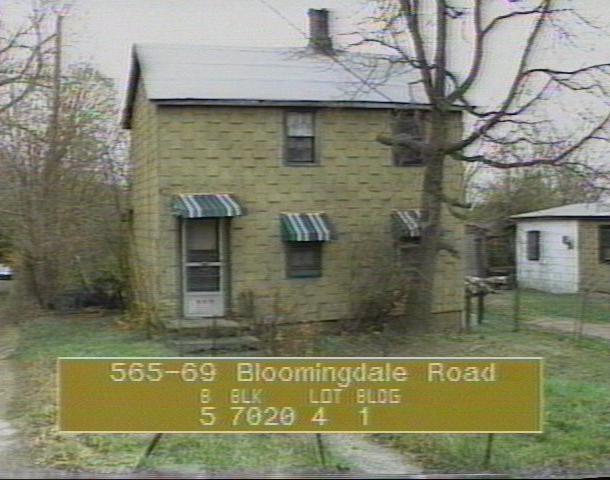
The city photographed every building for its tax records around 1940 and again in the 1980s. NYC Municipal Archives.
Written with AI from the source each entry cites, then fact-checked.
- 1900
Oysterman William D. Landin, son of a famed Maryland oyster planter, moves into No. 569
The 1900 census places William Dawson Landin here with his wife, Ella Bishop Landin, and daughter Beatrice. His father, Robert Landin, was among the most successful of the Maryland oystermen who came to Sandy Ground around 1850. William ran his own oyster business until about 1920 and afterward became the first African American man hired at the S.S. White Dental Works. He stayed at No. 569 until about 1930.
- 1923
Girard Bevans, living at No. 569, joins the city's handful of Black police officers
Landin's son-in-law Girard Bevans was living in the house by 1920 with his wife Beatrice and their baby son, and was laboring at a fertilizer plant nearby. He had joined the police by 1923, posted for much of his career in Harlem. In 1929 the city had only 90 Black officers among 18,000, and the Amsterdam News ran his photograph in January 1930 on his promotion to patrolman, first grade.
“By 1923 he had become a police officer, one of two who lived in the village of Sandy Ground…”
- 1930
The McDonalds rent No. 569, where neighbors turn a shared water pipe into a knock-code telephone
When the Bevans and Landin families moved to a new house at 591 Bloomingdale Road in 1930, No. 569 was rented to Geraldine and Hugh McDonald. After running water arrived on one meter for all three houses on the lot, the McDonalds, the Moores next door and the Henrys out back sent signals by snapping a faucet on and off. The number of knocks in the pipe told a given household to step outside for a message.
“…devised a “telephone system” – turning the faucet on and off sharply so that it knocked a certain number of times…”
- 1953
Lois Mosley, future author of Sandy Ground Memories, settles here with a former Black Yankees player
Lois Henry Mosley grew up in the house behind No. 569, and her mother Susan Landin Henry moved into No. 569 in the 1940s. In 1953 Lois and her husband Glenby Mosley, a local man who had played for the Black Yankees late in the Negro League era before joining the city Sanitation Department, moved in. They left for Mariner's Harbor in 1957. Lois later co-wrote Sandy Ground Memories, published in 2003.
“In 1953 Lois Henry Mosley and her husband Glenby Mosley…”
- 2011
The church-owned baymen's cottages become a city landmark
The Rossville AME Zion Church trustees bought the property in 1981. On February 1, 2011 the Landmarks Preservation Commission designated Nos. 565 and 569 as landmarks. It called them rare survivors from Sandy Ground's prosperous years as an African American settlement, and typical of the small cottages built for workers in rural New York in the late 1800s and early 1900s.
Nearby
- 565 Bloomingdale Road Cottage565 Bloomingdale Road | 4 entries
- Rossville AME Zion Church584 Bloomingdale Road | 4 entries
- Reverend Isaac Coleman and Rebecca Gray Coleman House1482 Woodrow Road | 4 entries
- Staten Island Pavilion3080 Arthur Kill Road | 2 entries
- Woodrow Methodist Church1101 Woodrow Road | 4 entries
- Abraham J. Wood House5910 Amboy Road | 3 entries