577 Hudson Street
also 575 Hudson Street | West Village | built 1900
Open on the map4 entries

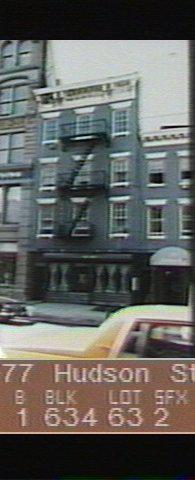
The city photographed every building for its tax records around 1940 and again in the 1980s. NYC Municipal Archives.
Written with AI from the source each entry cites, then fact-checked.
- 1869
A thief robs Henry Romer's coal yard office at 577 Hudson while a customer's partner distracts him
Before the present building, Henry Romer's coal yard occupied the lot, an earlier use of the site. On January 11, 1869, George Stevens and a companion asked the price of stove coal, and Stevens asked to inspect it, drawing Romer out into the yard. Romer heard the office door slam and found that the companion had taken $50. He chased Stevens, who was arrested, but the other man got away.
Source: Daytonian in Manhattan
- 1870
Architect W. H. Hoffman files plans for twin brick tenements at 577 and 579 Hudson Street
In February 1870 W. H. Hoffman filed plans for two three-story brick tenements for H. P. Holzderber, replacing the coal yard. Finished that year, they had brick fronts above the storefronts and cornices on modest block-like brackets. A tailor, Phillip Gross, leased the store at No. 577, and a clerk and a saloonkeeper shared the upper floors. Above the much-altered storefront, the 1870 facade remains unchanged.
Source: Daytonian in Manhattan
- 1875
Tea merchant Henry Menager leaves his 577 Hudson boarding room for Ohio and vanishes for months
Menager boarded with Mrs. E. Munroe Hill and left on October 2, 1875, for Gallipolis, Ohio. When relatives wrote in January asking about him, friends feared he had been robbed and killed, and searched along his train route. A suit by the United States Tea Company over a $1,875 loan due five days after he left suggested another explanation. In January 1876 an Ohio paper reported that he had turned up in Selma, Alabama.
Source: Daytonian in Manhattan
- 1891
William F. White takes over 577 Hudson as a crockery and hardware store and buys the building in 1910
In 1891 William F. White leased the building, ran a crockery and hardware store on the ground floor and rented rooms above, after spending $50 to update the show windows. He bought the property in October 1910 and kept the hardware business going through the 1920s. A 1929 renovation put two apartments on each upper floor above the shop of John Migladsky, known as John the Shoe Man.
Source: Daytonian in Manhattan
Further reading
- W. H. Hoffman's 1870 577 Hudson StreetDaytonian in Manhattan
- Then & Now photos: 575 Hudson StreetVillage Preservation: Greenwich Village Then & Now
Nearby
- 92 Bank Street1 entry
- Thorn Walling House94 Bank Street | 4 entries
- 767 Greenwich Street2 entries
- 765 Greenwich Street1 entry
- 96 Bank Street1 entry
- 763 Greenwich Street1 entry