Samuel Pell House
586 City Island Avenue | City Island | built 1970
Open on the map4 entries

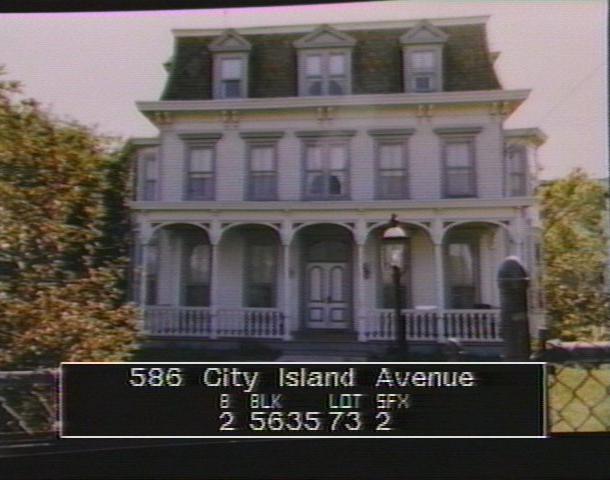
The city photographed every building for its tax records around 1940 and again in the 1980s. NYC Municipal Archives.
Written with AI from the source each entry cites, then fact-checked.
- 1876
Oysterman Samuel Pell builds a fifteen-room house for his family on Main Street
Samuel Pell, a descendant of the Pells of Pelham Manor and apparently one of City Island's leading oystermen, bought this lot in December 1875 and evidently built the house soon after. He and his wife Elizabeth Scofield had twelve children, and the fifteen rooms included five bedrooms, a parlor, a music room, a breakfast room and quarters for servants. The Landmarks Preservation Commission read its size as evidence of how well the oyster trade paid in the 1870s.
“The size of the house, which had fifteen rooms, including five bedrooms a parlor, music room, breakfast room, and servants quarters…”
- 1893
Samuel Pell sells the house to his daughter as his son's forgery scandal breaks
Pell's eldest son Sherman, a Westchester County supervisor for the Town of Pelham from 1886 to 1893, failed to hand over the town's books and money after his term and fled to Florida. In June 1893 investigators found he had forged the town clerk's signature on loans. Samuel and his son Percy had been Sherman's bondsmen, and on June 30, roughly a month before Pelham sued them for $10,000, Samuel sold the house to his daughter Lydia Scofield, a successful real estate dealer.
“On June 30th, a little over a month before the Town of Pelham brought suit against him and Percy for $10,000, Samuel Pell sold…”
- 1928
New York Giants lawyer Edgar Feeley takes over his family's house
Lace-curtain dealer James J. Feeley had bought the house in 1907, and after his death in 1928 his son Edgar bought out the other heirs. Edgar was a partner of Leo J. Bondy, counsel to Giants owner Charles A. Stoneham; after Bondy died in 1944 he became treasurer of the National Exhibition Company, took over the Giants' legal affairs and often spoke for the club. When the Giants left for the West Coast in 1957, he stayed in New York to look after the Polo Grounds until the ground lease ran out in 1962.
- 1972
Edgar Feeley dies and leaves the house to his companion, antiques dealer Tyne Burne
Edgar Feeley lived here from the late 1920s until his death in 1972, when the house went to Tyne Burne, his mistress, who had been living with him and ran an antiques shop in Scarsdale. She stayed until 1983. Several owners followed, including Cynthia and Vladimar Kvetan from 1987 to 2000, and the Landmarks Preservation Commission designated the house on October 29, 2002, while it remained a residence.
“At his death in 1972, No. 586 passed to Feeley' s mistress Tyne Burne, an antiques dealer with a shop in Scarsdale…”
Nearby
- 21 Tier Street House21 Tier Street | 4 entries
- Public School 102 (City Island School)190 Fordham Street | 4 entries
- William H. Schofield House65 Schofield Street | 4 entries
- Orchard Beach Bathhouse14 Park Drive | 5 entries