59 Greenwich Avenue
West Village | built 1845
Open on the map4 entries

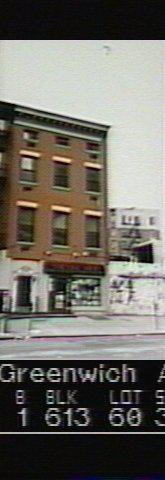
The city photographed every building for its tax records around 1940 and again in the 1980s. NYC Municipal Archives.
Written with AI from the source each entry cites, then fact-checked.
- 1845
William Van Hook builds Nos. 57 and 59 Greenwich Avenue as late Greek Revival town houses
The two brick houses at 57 and 59 Greenwich Avenue were built for William Van Hook in 1844-45, in the late Greek Revival style. Van Hook was a lawyer who owned a sawmill at Bank and West streets, and he lived on West Eighth Street before moving to 5 Fifth Avenue. The low top-floor windows still show their original form at No. 59, and both houses had shops at street level.
“These two handsome brick town houses, which once adjoined the brewery building to the north, were built for William Van Hook in 1844-45.”
- 1869
Fireman Thomas Roberts, who lived here, is killed leaping from a tender on the way to a fire
Thomas Roberts, a professional firefighter since 1865, lived in the house with his wife and two children. On the evening of October 24, 1869, Engine Company No. 14 raced to a blaze at Dodd's City Express stables on West 28th Street. Roberts, an assistant foreman, jumped from the moving tender, caught his foot in a strap and fell under its wheels. He was killed almost at once.
Source: Daytonian in Manhattan
- 1924
Horace Gregory, listed among the residents, founds Folio, a magazine of loose leaves in a portfolio
Daytonian in Manhattan lists the poet Horace Gregory among the building's post-World War I residents. In 1924 he established Folio, an unusual literary magazine issued as loose leaves in a portfolio, each contributor owning one leaf. Gregory said it had no angel, no editor and no policy, and Poetry magazine noted it kept no publication schedule.
Source: Daytonian in Manhattan
- 1962
Barretts of Cape Cod opens a fudge and penny-candy shop on the ground floor
Late in 1962 the Provincetown candy firm Barretts of Cape Cod moved into the store, making fudge in the window on a gas stove. The Village newspaper reported a 70-year-old recipe, seven regular flavors and more than 150 penny candies for children to pick from. In 1963 New York Times writer June Owen judged children and adults about equally thrilled by the penny candies.
Source: Daytonian in Manhattan
Further reading
- Poetry, "Long Torsos," and Fudge -- the 1845 59 Greenwich AvenueDaytonian in Manhattan
- Then & Now photos: 59 Greenwich AvenueVillage Preservation: Greenwich Village Then & Now
Nearby
- 57 Greenwich Avenue2 entries
- 179 7th Avenue South1 entry
- 175 7th Avenue South1 entry
- 55 Greenwich Avenue2 entries
- 66 Greenwich Avenue1 entry
- 53 Greenwich Avenue1 entry