Algonquin Hotel
59 West 44th Street | Midtown | built 1902
Open on the map14 entries

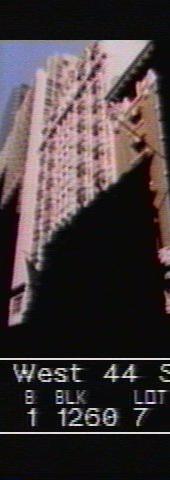
The city photographed every building for its tax records around 1940 and again in the 1980s. NYC Municipal Archives.
Written with AI from the source each entry cites, then fact-checked.
- 1902
The Algonquin opens, renamed from the Puritan
Designed by Goldwin Starrett, the 12-story hotel opened on November 22, 1902. It was meant to be called the Puritan; by one account clerk Frank Case talked the owners into the name Algonquin. Case leased the hotel in 1907 and bought it in 1927, and under him it courted writers and actors, started its tradition of a resident lobby cat, and became the first major New York hotel to take unaccompanied women as guests.
Source: Wikipedia
- 1905
A 1905 Times piece explains why West 44th Street is nicknamed Rubberneck Row
Around 1900 the block of West 44th Street between Fifth and Sixth Avenues held the Harvard Club, the Yale Club, the New York Yacht Club and the Bar Association, along with new residential hotels such as the Algonquin and the Royalton. Delmonico's and Sherry's, the city's most prestigious restaurants, were close by. A 1905 New York Times article said sightseeing-coach barkers coined the nickname because passengers kept turning their heads to look at the clubs.
Source: Ephemeral New York
- 1905
The Hippodrome opens across 44th Street, which Frank Case calls an important event for the hotel
The New York Hippodrome opened directly across 44th Street from the Algonquin in 1905, and Frank Case later described it as an important event for the hotel. Manhattan's theater district was shifting toward Times Square at the time, and the block was becoming an entertainment district. Luna Park developer Fred Thompson lived on the top story of the hotel's annex, while Florenz Ziegfeld Jr. and Diamond Jim Brady were regulars in its cafe.
“The New York Hippodrome opened directly across 44th Street in 1905, which Case described as "an important event for us". ... Luna Park developer Fred Thompson lived on the annex's top story…”
Source: Wikipedia
- 1912
A man found on the fire escape of Charlotte Walker's room is held over French postcards
On October 13, 1912, screams came from the rooms of the actress Charlotte Walker, who had woken to find a man inside. Frank Case flung open the door and saw a figure on the fire escape, and hotel staff caught him. He turned out to be Paul Renaud, a 37-year-old Frenchman. A magistrate was ready to free him for lack of evidence of burglary until Case mentioned indecent postcards found on him, and he was held on $500 bail.
Source: Daytonian in Manhattan
- 1917
Frank Case shuts the hotel bar years before Prohibition
In 1917, ahead of the Volstead Act, Frank Case decided to close the Algonquin's bar, declaring that he was not a rum-seller. The Landmarks Preservation Commission presents the step as part of how Case kept up the refined atmosphere he had so carefully built around the hotel. Case had come to run the hotel himself in 1907 and was building its reputation as a haven for actors and writers.
- 1919
A practical joke on Alexander Woollcott starts the Algonquin Round Table
In June 1919 press agent John Peter Toohey staged a mock welcome lunch at the Algonquin for critic Alexander Woollcott, back from World War I. The writers who came, among them Dorothy Parker, Robert Benchley, George S. Kaufman, Robert E. Sherwood and Harold Ross, kept lunching together at the hotel almost daily for about ten years. Ross went on to found The New Yorker.
Source: Wikipedia
- 1929
A stray cat named Rusty becomes the Algonquin's first house cat
A stray cat wanders into the Algonquin's lobby in the late 1920s and is taken in as Rusty. Actor John Barrymore later renames him Hamlet, and staff continue the tradition afterward: every male lobby cat at the hotel becomes a Hamlet and every female a Matilda. The hotel keeps eight Hamlets and three Matildas over the following decades.
Source: Wikipedia
- 1932
Frank Case buys full ownership of the Algonquin Hotel
Frank Case, who joined the Algonquin as a young clerk during its construction and talked owner Albert Foster into renaming it from the Puritan, purchases the hotel outright in 1932 for $717,000. Case has already managed the Algonquin for decades and hosted its Round Table crowd through the 1920s. He continues running the hotel until his death in 1946.
Source: Daytonian in Manhattan
- 1935
The New York Drama Critics' Circle is founded at the Algonquin and begins holding annual dinners there
Critics founded the New York Drama Critics' Circle at the Algonquin in 1935, and from then on the group held annual dinners at the hotel where members voted on the best play of the year. By then the hotel was a regular gathering place for the theater world: Frank Case wrote in 1938 that it was not unusual to see five, six or seven well-known writers there at the same moment.
“After the New York Drama Critics' Circle was founded at the Algonquin in 1935, it started hosting annual dinners at the hotel…”
Source: Wikipedia
- 1939
Algonquin staff join a union and strike, and Frank Case signs a contract
Workers at the Algonquin joined a union tied to the AFL in 1939, then walked off the job. Frank Case, who owned and ran the hotel, negotiated a contract with the union that April. The staff have stayed unionized ever since.
Source: Wikipedia
- 1943
Waitress Elizabeth Bird becomes the Algonquin's sommelier, renamed Francine
In 1943 the hotel's well-known sommelier, Francois, left because of failing health. Waitress Elizabeth Bird wanted the job even though her only training in wine was a book she had read. Frank Case gave it to her and insisted she be called Francine. The New York Times described her as likely the only woman in town who got to tell fastidious men which wines to drink.
Source: Daytonian in Manhattan
- 1959
Preston Sturges dies at the Algonquin while writing his memoir
The filmmaker Preston Sturges died of a heart attack at the Algonquin on August 6, 1959, while working on his autobiography. He had intended to title the book The Events Leading Up to My Death. He was buried at Ferncliff Cemetery in Hartsdale, New York, and the manuscript stayed unpublished until 1990.
Source: Wikipedia
- 1987
The city designates the Algonquin a landmark for its literary and theatrical history
The Landmarks Preservation Commission designated the hotel a landmark on September 15, 1987, after hearings spread over 1985 and 1986. Four witnesses spoke in favor, and three representing the owner opposed. The designation report describes the Algonquin as a place that hosted generations of famous literary and theatrical figures, most often linked to the Round Table, and credits the hotel's character to its proprietor Frank Case.
“A total of four witnesses spoke in favor of designation. Three witnesses representing the owner spoke in opposition to designation.”
- 2004
The Algonquin closes completely for the first time and reopens with a $10,000 martini
Owner Miller Global shut the Algonquin entirely in June 2004, the first full closure in its history, and used the time to add high-speed internet and flat-screen televisions to the rooms. The hotel reopened in August 2004. General manager Anthony Melchiorri marked the occasion with a $10,000 martini that came with a diamond resting at the bottom of the glass.
“Miller Global closed the Algonquin entirely in June 2004; this was the first time that the Algonquin had been fully closed in its history.”
Source: Wikipedia
Further reading
- Algonquin HotelWikipedia
- The 1902 Algonquin Hotel -- No. 59 West 44th StreetDaytonian in Manhattan
- The midtown block dubbed “Rubberneck Row”Ephemeral New York
Nearby
- Iroquois Hotel49 West 44th Street | 10 entries
- Cassa Hotel & Residences66 West 45th Street | 1 entry
- Royalton Hotel44 West 44th Street | 8 entries
- Sofitel New York45 West 44th Street | 6 entries
- New York Yacht Club Building37 West 44th Street | 9 entries
- Webster Hotel40 West 45th Street | 2 entries