Fuller Building
595 Madison Avenue | also 51 East 57th Street, 41 East 57th Street, 597 Madison Avenue | Midtown | built 1929
Open on the map13 entries

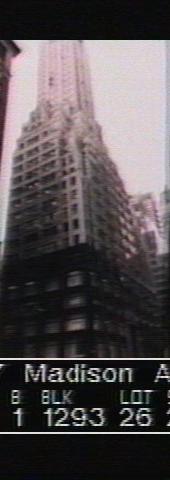
The city photographed every building for its tax records around 1940 and again in the 1980s. NYC Municipal Archives.
Written with AI from the source each entry cites, then fact-checked.
- 1928
The Fuller Company buys a church at 57th and Madison to build a new headquarters
In May 1928 the George A. Fuller Company paid $3 million for the Central Presbyterian Church at Madison Avenue and 57th Street, a building put up in 1870 for the Madison Avenue Dutch Reformed Church. The congregation moved to Park Avenue. A real-estate subsidiary formed by the company's parent planned a 30-story tower on the corner and hired Walker & Gillette to draw it.
Source: Wikipedia
- 1929
The Fuller Company sets its name in huge letters over the 57th Street entrance, remembering the Flatiron
The Fuller Company's earlier headquarters, which rose in 1902 where 23rd Street, Fifth Avenue and Broadway meet, was always called the Flatiron Building instead, and the New York Times noted that its official name had been practically forgotten. For the Madison Avenue tower, the company took no chances. The words FULLER BUILDING were set in huge lettering below Elie Nadelman's sculpture above the 57th Street entrance.
Source: Daytonian in Manhattan
- 1929
The Fuller Building lets shops stack up to six floors high, each with a private elevator
Walker & Gillette planned the base as a set of vertical shops. A retailer could take a ground-floor storefront plus the floors directly above it and install its own elevator for them. Above the shops, floors six through fifteen were meant as a trade center where art dealers and interior decorators could show their goods, with offices in the tower. The architects billed it as the city's first high-class, multi-purpose skyscraper.
“…possible for a retail tenant to lease space in up to six floors, directly above the store, and install a private elevator for access to each so-called vertical shop…”
- 1929
Despite the stock market crash, floors seven through 20 of the Fuller Building are leased within two months
Within two months of completion, and despite the onset of the Great Depression, all the space from the seventh floor through the twentieth had been leased. The George A. Fuller Company itself took four of those floors, the 16th through the 19th, for its headquarters.
Source: Daytonian in Manhattan
- 1929
The Fuller Building is finished, and the Fuller Company moves into its upper floors two days later
The tower was completed on September 7, 1929, and the Fuller Company became its first tenant, taking the 16th through 19th floors. The company had wanted its earlier headquarters, now the Flatiron Building, to carry the Fuller name, but the public chose a nickname instead. This time it lettered the name over both the 57th Street and Madison Avenue entrances.
Source: Wikipedia
- 1929
Walker & Gillette wrap the base in black granite, with a Nadelman sculpture over the entrance
Walker & Gillette clad the lowest six floors in black Swedish granite, with big display windows for shops and galleries, and stepped the upper tower back to meet the 1916 zoning rules. Above the three-story entrance on 57th Street, Elie Nadelman carved a limestone group of two construction workers on either side of a clock, set against a skyline. The design was conservative Art Deco.
Source: Wikipedia
- 1931
Pierre Matisse, Henri Matisse's son, opens his gallery in the Fuller Building
Pierre Matisse, the youngest child of the painter Henri Matisse, had settled in New York in 1924 and worked as an art dealer. In 1931 he opened his own gallery at 41 East 57th Street, in the Fuller Building, and kept it going until his death in 1989. He often gave European artists their first New York shows, among them Joan Miró, Marc Chagall, Alberto Giacometti and Jean Dubuffet.
“In 1931, Matisse opened his own gallery in the Fuller Building at 41 East 57th Street in New York City.”
Source: Wikipedia
- 1968
The Fred F. French Company contracts to buy the Fuller Building, years after investors reshaped its leases
In 1961 the investor Lawrence Wien bought the building's lease from the Fuller Building Corporation, and a syndicate led by Irving Brodsky and Richard Gittlin took a 99-year lease on the land. Leases on about half the office space were due to expire in 1962, so the new owners renovated the air conditioning, lighting and ceilings. In 1968 Brodsky contracted to buy the Fuller Building for the Fred F. French Company, which put up cash to retire a $4.2 million mortgage.
“In 1968, Brodsky signed a contract to purchase the Fuller Building on behalf of the Fred F. French Company, which paid cash to cover the $4.2 million mortgage.”
Source: Wikipedia
- 1978
Art galleries fill much of the lower six floors of the Fuller Building
By the 1970s the shop floors of the Fuller Building were largely occupied by art galleries, drawn by management that supplied wide doorways, few windows and floors strong enough for heavy works. Tenants over the years included Pierre Matisse, Charles Egan, Andre Emmerich, Marlborough-Gerson and Tibor de Nagy. Writing for the Times in 1978, Carter Horsley noted that few buildings kept shops on more than two levels.
Source: Wikipedia
- 1986
The city designates the Fuller Building's exterior and lobby as separate landmarks
On March 18, 1986, the Landmarks Preservation Commission protected both the exterior of the Fuller Building and its first-floor interior. The T-shaped lobby has marble walls, bronze elevator doors with relief panels of building construction, and floor mosaics made by Vincent Foscato. Three roundels in the floor show the Fuller Company's Tacoma Building, Flatiron Building and Fuller Building.
Source: Wikipedia
- 1999
Vornado Realty Trust buys the Fuller Building for about $125 million
Vornado Realty Trust agreed in August 1999 to buy the Fuller Building for roughly $125 million and closed the purchase the following month. The mortgage holder, L&B Group, had retaken the building in December 1994, after it stood more than a quarter vacant, and then renovated it. In 2002 Vornado proposed a redesign of the base by Skidmore, Owings & Merrill, including glass over the entrance that could switch between clear and opaque; the plan drew opposition.
Source: Wikipedia
- 2005
Owners announce plans to turn the Fuller Building's upper floors into luxury condominiums
Owners of the Fuller Building announced in 2005 that they planned to convert its upper floors to luxury residential condominiums. The Landmarks Preservation Commission describes the tower as an outstanding example of Art Deco skyscraper design.
Source: Daytonian in Manhattan
- 2005
Coach opens its global flagship in the Fuller Building, later replaced by Berluti and Fendi
Coach made the Fuller Building home to its worldwide flagship in 2005, then closed the shop without warning in January 2020. Berluti took a portion of that space in December 2020, and Fendi followed that July with a two-level store in another portion. Bottega Veneta and Tom Ford were also tenants, and the tower was 81 percent occupied by the end of 2021.
Source: Wikipedia
Further reading
- Fuller BuildingWikipedia
Nearby
- Four Seasons Hotel New York55 East 57th Street | 7 entries
- LVMH Tower19 East 57th Street | 6 entries
- 432 Park Avenue22 entries
- IBM Building590 Madison Avenue | 12 entries
- Pepsi-Cola Building500 Park Avenue | 8 entries
- 3 East 57th Street4 entries