Bowery Ballroom
6 Delancey Street | Lower East Side | built 1920
Open on the map9 entries

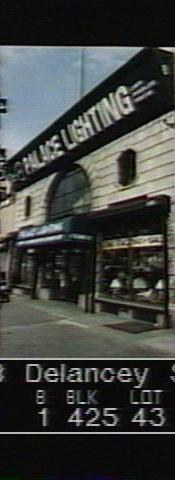
The city photographed every building for its tax records around 1940 and again in the 1980s. NYC Municipal Archives.
Written with AI from the source each entry cites, then fact-checked.
- 1898
Police arrest Carl Werner for running a brothel in the old house at 6 Delancey
By the 1890s many Federal-style houses on Delancey Street near the Bowery had been demolished or converted to business use. No. 6 Delancey Street still stood in 1898, and Carl Werner was arrested there that year for operating a disorderly house, meaning a brothel. The old building lasted nearly two more decades. This entry concerns an earlier building on the lot.
Source: Daytonian in Manhattan
- 1914
A motion-picture theater called the Delancey opens on the site
In 1914, theater owners Meyer & Schneider hire architect Lorenz Weiher to build a 500-seat motion-picture house on the lot at 6 Delancey Street. Later known as the M. & S. Theatre or the Delancey, it operates as a movie house for over a decade. The building is demolished in 1928 to make way for the retail structure that later becomes the Bowery Ballroom.
Source: Daytonian in Manhattan
- 1929
A high-end shoe store is built at 6 Delancey Street just before the crash
The building at 6 Delancey Street was put up in 1929 as a high-end shoe store and haberdashery, just before the Wall Street crash. It stood empty until after World War II, then held a succession of shops as the neighborhood declined.
Source: Wikipedia
- 1934
Tree-Mark Shoes advertises a new $6.95 model in a Depression-era ad
Tree-Mark Shoes, the orthopedic shoe firm that ran the store here, advertised in Yiddish-language papers and Jewish magazines because the district's population was heavily Jewish. In a 1934 ad in the Brooklyn Jewish Center Review, it said its shoes had sold for $8.50 to $13.50 for 18 years, then announced a new model at $6.95 to meet the need for financial adjustment.
Source: Daytonian in Manhattan
- 1997
Renovators preserve the shoe store's brass rails and coffered ceiling
When Michael and Brian Swier convert the former Tree-Mark shoe store into the Bowery Ballroom in 1997, much of the 1929 retail interior is lost, but several original details survive: brass rails, iron-and-brass exterior metalwork, mahogany-lined rooms now used as VIP space, and the coffered plaster ceiling above the mezzanine bar. The venue's founders keep running it themselves in the years afterward.
Source: Daytonian in Manhattan
- 1998
The Mercury Lounge team opens the Bowery Ballroom
Michael Swier, Michael Winsch and Brian Swier, who already ran the Mercury Lounge, opened the Bowery Ballroom in 1998 after a full renovation designed by Brian Swier with acoustics in mind. The standing-room venue holds 575 people. Patti Smith played New Year's Eve shows here fourteen years in a row, and in 2013 Rolling Stone ranked it the best club in America.
Source: Wikipedia
- 2003
A federal transit study praises the former shoe store as Italian Renaissance design
In March 2003 the Federal Transit Administration's environmental impact statement for the Second Avenue Subway evaluation called the Tree-Mark Shoe Building a fine specimen of Italian Renaissance-style commercial architecture. Its architect, Henry Creighton Ingalls, who also designed the Henry Miller Theatre, gave the 1929 building a double-height arched entrance and a rusticated limestone facade.
Source: Daytonian in Manhattan
- 2004
Joan Baez records her live album Bowery Songs at the ballroom
On November 6, 2004, Joan Baez recorded a live performance at the Bowery Ballroom that became the album Bowery Songs, named for the venue. The club, which had opened six years earlier in the former shoe store, has a capacity of 575 people.
“Joan Baez's Bowery Songs album, recorded live at the venue on November 6, 2004.”
Source: Wikipedia
- 2013
Rolling Stone's industry poll names the Bowery Ballroom the best club in America
In 2013 Rolling Stone polled industry insiders and named the Bowery Ballroom the best club in America, praising its mix of intimacy and grandeur, consistent sound and good sightlines. Consequence of Sound placed it second among the country's best music venues.
“In 2013, industry insiders polled by Rolling Stone magazine named it the best club in America…”
Source: Wikipedia
Further reading
- Bowery BallroomWikipedia
- The 1929 Tree-Mark Shoe Building (Bowery Ballroom) - 6 Delancey StreetDaytonian in Manhattan
- When the Bowery Ballroom was a shoe store and other scenes from Delancey Street in the 1930sThe Bowery Boys
Nearby
- Dixon Place161A Chrystie Street | 3 entries
- Miner's Bowery Theatre site169 Bowery | 4 entries
- 165 Bowery1 entry
- 2 Spring Street188 Bowery | 3 entries
- Hammacher Schlemmer's Bowery store209 Bowery | 3 entries
- 1 Rivington Street3 entries