Samuel Cooke House
60 West 11th Street | Greenwich Village | built 1843
Open on the map5 entries

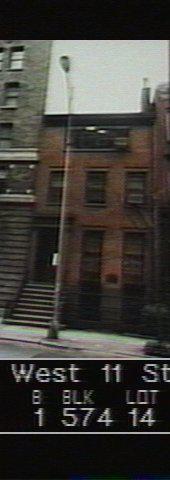
The city photographed every building for its tax records around 1940 and again in the 1980s. NYC Municipal Archives.
Written with AI from the source each entry cites, then fact-checked.
- 1843
Andrew Lockwood builds No. 60 as one of a pair of small Greek Revival houses
The builder Andrew Lockwood erected this three-story Greek Revival house in 1843 as one of a pair. Its twin was later replaced by the apartment house at No. 56. A full-width steel-sash window was later added to the top floor for studio use, but the cornice, doorway and stair handrails still match the neighboring row to the east.
- 1851
Rev. Samuel Cooke, brought from New Haven by the St. Bartholomew's congregation, moves into No. 60
Samuel Cooke arrived from New Haven in 1851, invited by the St. Bartholomew's Episcopal congregation, whose church stood at Lafayette and Great Jones Streets and whose members included Vanderbilts. His family lived at 60 West 11th Street, a house owned by the wealthy landowner James Gallatin rather than the church. Cooke stayed at St. Bartholomew's until 1887. His eldest son, Samuel Walden Cooke, a Columbia senior, died suddenly on December 9, 1864.
Source: Daytonian in Manhattan
- 1888
Zefita Gallatin sues her in-laws over her inheritance, starting a legal fight that lasts seven years
James Gallatin left No. 60 to his grandson Albert Lewis Gallatin, who died in 1880 at 31 and left his widow Zefita $100,000. On March 28, 1888 she went to court against James F. Gallatin, her brother-in-law, and Harriet Gallatin, her mother-in-law, to keep her inheritance. The case lasted until June 1895, when Zefita, by then Countess Rohan-Chabot and living in Europe, withdrew her objections in return for income on $100,000.
Source: Daytonian in Manhattan
- 1910
Tenant Edward B. Taber helps found a company to organize a 1913 World's Fair
Edward B. Taber was a resident by 1910, the year he became a founder of the New York Advancement Company, which set out to stage a World's Fair in 1913. The fair was meant to mark the 300th anniversary of the first European settlement on Manhattan Island.
Source: Daytonian in Manhattan
- 1942
Dr. Herman Kasha is tried in a sensational 1942 case over an alleged abortion clinic on the first two floors
Dr. Herman L. Kasha leased the first and second floors in December 1933 for $3,120 a year and opened a medical practice there. By 1942 he was in court, where the sensational trial charged that his office had been an abortion clinic. Reportedly, doctors from around the city referred patients to the house between 1933 and 1938.
Source: Daytonian in Manhattan
Further reading
- The 1843 Samuel Cooke House -- No. 60 W 11th StreetDaytonian in Manhattan
Nearby
- Adolphe LeMoyne House62 West 11th Street | 3 entries
- New School Eugene Lang Annex64 West 11th Street | 4 entries
- 54 West 11th Street4 entries
- Enrico & Paglieri66 West 11th Street | 4 entries
- 70 West 11th Street3 entries
- Isabella Merritt Hawley House48 West 11th Street | 5 entries