Starrett-Lehigh Building
601 West 26th Street | also 608 West 27th Street, 212 12th Avenue, 259 11th Avenue | Chelsea | built 1931
Open on the map12 entries

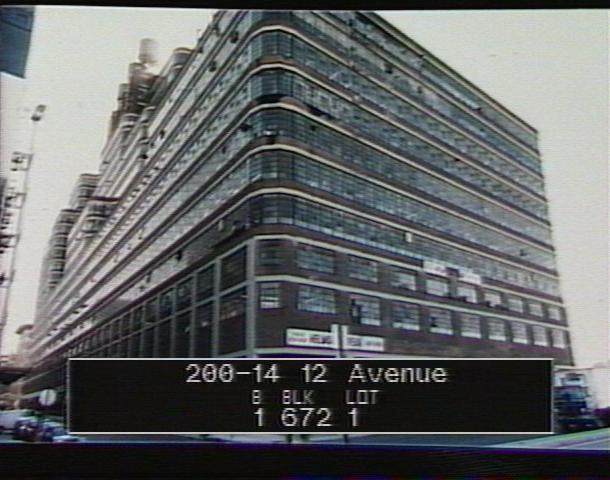
The city photographed every building for its tax records around 1940 and again in the 1980s. NYC Municipal Archives.
Written with AI from the source each entry cites, then fact-checked.
- 1900
The Lehigh Valley Railroad leases the landfill block for a freight yard
Before the present building, this block of filled land, first platted in 1858, was a railroad freight yard. The Lehigh Valley Railroad leased all of it in 1900 and ran a carloading operation here, close to other railroad terminals, the New York Central freight yard, the piers and the West Side Highway. In March 1930 the railroad's subsidiary, the Pioneer Real Estate Company, bought the land for a freight terminal and warehouse to be built over the rail spur.
- 1930
Builders strike bedrock 145 feet down at the west end and redraw the building's profile
Excavation turned up unforeseen trouble: bedrock lay only 45 feet down along the east edge of the block but more than 145 feet down at the west end. Crews drove clusters of 18- and 24-inch open-ended steel tubes to the rock. The ground also forced a redesign, turning a planned uniform 15-story building with a central penthouse into a 19-story middle section flanked by a 9-story west wing and an 18-story east wing.
- 1931
The Starrett-Lehigh Building opens as a freight terminal where trucks ride elevators
Built in 1930–31 as a rail and truck freight terminal, the building was designed by brothers Walter and Russell Cory with Yasuo Matsui. Rail cars were floated across the Hudson to Pier 66, and trucks drove into the building from 27th Street, rode freight elevators to loading docks on upper floors, and left by 26th Street. The idea was that every floor worked like a ground floor.
Source: Wikipedia
- 1931
Buckminster Fuller lives on the top floors of the new freight terminal
Among the first tenants of the terminal, which officially opened in the first week of December 1931, were the Gimbel Brothers, the Westminster Tire Company and the trucking firm W. C. Mulligan & Co. The architect R. Buckminster Fuller also made his home on the top floors. The Harrison S. Coburn Company handled the leasing.
“In addition, architect R. Buckminster Fuller lived on the building's top floors.”
Source: Wikipedia
- 1932
The Museum of Modern Art features the building in its Modern Architecture show
Its bands of steel strip windows and brick, rounded corners and setbacks earned the building a place in the Museum of Modern Art's 1932 exhibition Modern Architecture: International Exhibition, one of ten New York buildings shown. The Landmarks Preservation Commission designated it a landmark on October 7, 1986, and it later housed Martha Stewart Living Omnimedia and fashion firms.
Source: Wikipedia
- 1949
Owner Jacob Friedus is prosecuted for tax evasion after press profiles of his purchase
Jacob Friedus bought the building in November 1944, after the Lehigh Valley Railroad disassociated itself from it, taking over a $3.7 million mortgage that also covered the Lehigh-Bronx Building. Newspapers ran detailed profiles of the new owner, and the publicity led the Internal Revenue Service to investigate him. The IRS prosecuted Friedus for tax evasion in 1949.
“…the large amount of media coverage prompted the Internal Revenue Service to investigate him, and the IRS prosecuted Friedus in 1949 for tax evasion…”
Source: Wikipedia
- 1974
Harry Helmsley wins the failing building at a 1974 foreclosure auction
By 1973 only about 2,000 people worked in the building and 40 percent of it stood empty. Friedus could not pay down his mortgages, and the building went into receivership in May 1973. In August 1974 Harry B. Helmsley won it at a foreclosure auction, and his firm Helmsley-Spear took over, hoping to restore a first-class manufacturing and warehouse building. Mayor Abraham Beame later urged that vacant floors be leased to garment makers.
“The Starrett–Lehigh Building was sold at a foreclosure auction in August 1974 to Harry B. Helmsley.”
Source: Wikipedia
- 1986
The city designates the Starrett-Lehigh Building a landmark
New York City designates the Starrett-Lehigh Building an individual landmark on October 7, 1986, recognizing Cory & Cory and Yasuo Matsui's 1931 design for the Lehigh Valley Railroad's freight terminal. The building's ribbon windows and cantilevered concrete floors, built to let trucks drive directly onto loading docks, had already drawn admiration from modernist architects for decades. In 2008 it is folded into the larger West Chelsea Historic District.
Source: Wikipedia
- 1998
A syndicate buys the freight terminal for $152 million
A group of investors including Mark Karasick, David Werner, and First Boston purchases the Starrett-Lehigh Building for $152 million in 1998, decades after Harry Helmsley had taken it over at foreclosure in 1974. By then the printing firms and sportswear companies that once filled its floors have given way to art galleries and a new wave of tenants. The sale sets up the building's transition into a hub for media and technology firms.
Source: Wikipedia
- 1999
Dot-com tenants like Martha Stewart Living move into the terminal
By 1999, dot-com companies make up about a third of the tenants inside the Starrett-Lehigh Building, among them Martha Stewart Living Omnimedia. Martha Stewart continues using the building's one remaining freight elevator for years afterward, a holdover from its days as a trucking terminal where vehicles rode elevators to upper floors.
Source: Wikipedia
- 2007
The last manufacturer leaves the Starrett-Lehigh Building
The Skyscraper Museum's walkthrough of its Vertical Urban Factory exhibition says the last manufacturer moved out of the Starrett-Lehigh Building in 2007. The Starrett brothers had rented whole, multiple and partial floors to printers, doll makers, clothing manufacturers and die cutters. The museum says the floors are now leased as office and studio space to design, lifestyle and fashion businesses.
Source: old.skyscraper.org
- 2012
Superstorm Sandy floods the basement and shuts the building down
RXR Realty bought the building in 2011 for $920 million and began $50 million in capital improvements. Then, in October 2012, Superstorm Sandy sent 2.5 million gallons of seawater into the basement, according to Commercial Observer's timeline of the building, and the whole complex shut down. The storm hit the year after the purchase.
Source: commercialobserver.com
Further reading
- Starrett–Lehigh BuildingWikipedia
Nearby
- Terminal Warehouse261 11th Avenue | 5 entries
- Eagle NYC554 West 28th Street | 4 entries
- 3Eleven311 11th Avenue | 1 entry
- 606 West 30th Street2 entries
- The McKittrick Hotel (Sleep No More)530 West 27th Street | 9 entries
- John H. Young Studio536 West 29th Street | 4 entries