International Building
626 5th Avenue | also 45 Rockefeller Plaza, 9 West 50th Street, 10 West 51st Street | Midtown | built 1932
Open on the map13 entries

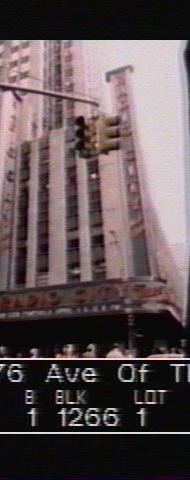
The city photographed every building for its tax records around 1940 and again in the 1980s. NYC Municipal Archives.
Written with AI from the source each entry cites, then fact-checked.
- 1932
Rockefeller Center courts eight countries and offers customs perks to fill its international buildings
Between 1932 and 1934, Rockefeller Center bargained over leases for its other international buildings with prospective tenants from Russia, Japan, China, Germany, Italy, Czechoslovakia, Holland and Sweden, along with a Pan-American group. To attract them, the Center offered a federal policy of delayed duty payments and a Customs Bureau on site, sparing tenants storage and shipping charges. Of all those prospects, just the Italian group turned into a lasting major tenant, which produced the Palazzo d'Italia beside the multi-tenant International Building.
“…tenant inducements included an attractive federal policy of delayed duty payments and the establishment of a Customs Bureau at Rockefeller Center…”
- 1933
A Fascist battle cry interrupts the groundbreaking for Rockefeller Center's Italian wing
Rockefeller Center broke ground on the Palazzo d'Italia, the Italian wing of its International complex, on July 12, 1933. A vice president of the Italian sponsoring company spoke of peaceful understanding among nations, but the ceremony was interrupted by crowds shouting the Fascist legions' battle cry. Mussolini had been shown a model and seemed pleased, yet no commitment from the Italian government followed, and Italian-American businesses carried the venture instead.
- 1935
Nelson Rockefeller gives craftsmanship awards to 31 workers on the International Building
Nelson Rockefeller held a ceremony in the building's lobby in April 1935 and presented craftsmanship awards to 31 of the workers involved in the project. Construction took 1.3 million man-hours, and only 5,000 man-hours were lost to accident delays. The low accident rate was credited to the contractors' modern safety measures and automatic equipment.
“In April 1935, Nelson Rockefeller hosted a ceremony in the International Building's lobby, giving craftsmanship awards to 31 workers who were involved in the project.”
Source: Wikipedia
- 1935
Sinclair Oil leases seven floors, taking the new tower to 40 percent occupancy
In July 1935, Sinclair Oil leased seven stories in the International Building, which brought the building's occupancy to 40 percent. Among the first tenants were booking offices of the Italian Line, Furness Withy and Cunard-White Star Line. When Sinclair moved into its own headquarters at 600 Fifth Avenue in the early 1950s, Simon & Schuster and Esso quickly took the seven floors it left behind.
Source: Wikipedia
- 1935
The 41-story International Building rises in 136 working days
Opened in 1935 as the seventh unit of Rockefeller Center to welcome tenants, the International Building stands 512 feet tall with two six-story wings flanking its forecourt. Steel climbed at roughly four feet a day, and just 136 working days passed between the first steel in the excavation and the finished tower. It was one of only two Manhattan skyscrapers completed that year, alongside Cass Gilbert's courthouse at Foley Square, and it carried an early Selective Cooling System.
“…only 136 working days elapsed from the setting of the first steelwork in the excavations until the opening of the 512 foot slab.”
- 1935
Gaston Lachaise's steelworker reliefs are unveiled over the Rockefeller Plaza entrance
Two limestone reliefs by sculptor Gaston Lachaise were unveiled on the building's Rockefeller Plaza side in May 1935. One shows two muscular steelworkers atop a hoisted I-beam, the other laborers clearing the site, and both were apparently inspired by construction photographs. They appeared a month after 31 building mechanics were honored for their work on the tower, and about five months before Lachaise died of leukemia.
“They were unveiled in May 1935, just one month after 31 building mechanics had been honored for their work on the International Building…”
- 1937
Lee Lawrie's 14,000-pound bronze Atlas takes its place in the forecourt
Sculptor Lee Lawrie designed the 15-foot Atlas that anchors the International Building's courtyard, with Rene Chambellan assisting and the Roman Bronze Works casting it in twelve parts. Rather than carrying the world as in the myth, this Atlas bears a 21-foot armillary sphere, an idea possibly prompted by Lawrie's son Milton, an architect and amateur astronomer. Like Prometheus, the figure it was designed to accompany, it is ringed by zodiac signs.
“Designed by Lee Lawrie and cast in twelve parts by the Roman Bronze Works, with the assistance of Rene Chambellan…”
- 1941
Nineteen consulates fill the building as the war forces two of them to close
By the start of 1941 the International Building had become a hub for consular offices, with 19 consulates. In June of that year the U.S. government forced the Italian consulate to close. When the U.S. joined the war that December, the Japanese consulate was closed as well, since the country was now at war with both Japan and Italy.
Source: Wikipedia
- 1941
A Fascist-era glass panel above the Palazzo d'Italia entrance is boarded over in late 1941
In late 1941, Attilio Piccirilli's 10-by-16-foot glass panel above the Palazzo d'Italia's main entrance was boarded up. It showed a heroic worker with a spade beneath the inscription Sempre Avanti, Eterna Giovinezza, a celebration of Fascist labor judged too conspicuous to keep. Giacomo Manzu's bronze relief replaced it in 1965. Higher on the facade, Leo Lentelli's limestone reliefs of four periods of Italian history stayed, including a panel with an eagle above the Fascist fasces.
“A too grand and conspicuous celebration of Fascist "Labor," the panel was boarded up in late 1941 and subsequently removed. It was replaced in 1965 by Giacomo Manzu's bronze high relief…”
- 1965
Giacomo Manzu installs a bronze Italia relief at the Palazzo d'Italia entrance
In 1965 the sculptor Giacomo Manzu replaced Piccirilli's removed panel with a bronze high relief spelling ITALIA above wheat stalks entwined with grapevines. He explained the motif as the immigrants' search for food and drink. He also added a small relief of an immigrant mother and child with their belongings in a bundle, placing it in the middle of three glass doors, a spot he argued was not a subway entrance.
- 1968
A bomb explodes outside the International Building, injuring two people
A bomb detonated outside the International Building in 1968. The blast caused only minor damage to the building, and two people were injured. Through that decade the tower also housed executive offices for firms including Xerox, Bulova and Executive House Hotels.
Source: Wikipedia
- 1978
Michio Ihara's metal sculptures are installed in the lobby's show windows
In 1978 Michio Ihara's metallic sculptures were installed in the lobby's show windows. When the lobby was built, the intent was also to use it for exhibitions, with the show windows as part of the display, but that scheme was not realized. Ihara designed his work to be seen from different angles, so its appearance shifts with the level and movement of each viewer passing through the space.
“…metallic sculptures of Michie Ihara (b. 1928) were installed in the show windows in 1978…”
- 1985
The Landmarks Commission designates the four-story entrance lobby and mezzanine as an interior landmark
On April 23, 1985, the Landmarks Preservation Commission designated the International Building's Fifth Avenue entrance lobby and its mezzanine as an interior landmark. At the September 1983 hearing, nineteen witnesses spoke in favor and no one opposed, while Rockefeller Center, Inc. backed only a limited designation. The commission called the lobby among the grandest and most dramatic interior spaces at Rockefeller Center, praising its form and its decorative finishes.
Further reading
Nearby
- British Empire Building620 5th Avenue | 13 entries
- Associated Press Building50 Rockefeller Plaza | 9 entries
- La Maison Francaise610 5th Avenue | 8 entries
- 650 Fifth Avenue650 5th Avenue | 8 entries
- 75 Rockefeller Plaza36 West 52nd Street | 10 entries
- George W. Vanderbilt Residence647 5th Avenue | 10 entries