Club 82
63 2nd Avenue | also 76 East 4th Street | East Village | built 1926
Open on the map6 entries

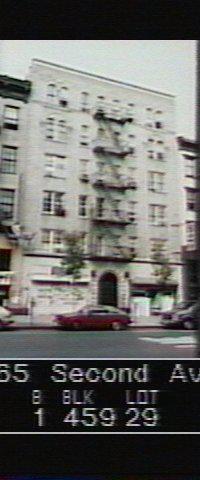
The city photographed every building for its tax records around 1940 and again in the 1980s. NYC Municipal Archives.
Written with AI from the source each entry cites, then fact-checked.
- 1926
Saul Birns completes his first apartment house, at 63 Second Avenue
Read more
Saul Birns, who developed many of the true apartment buildings that rose in this neighborhood in the 1910s and 1920s, completes his first project here in 1926. The six-story building was designed by Charles B. Meyers. It was the only residential commission Birns took within what is now the East Village historic district, and most of his later apartment houses stood north of it on Second Avenue.
“His first project, and his only residential commission within the historic district, was the six-story apartment house at 63 Second Avenue…”
- 1929
A speakeasy called the Rainbow Inn occupies the basement, sometimes raided
By 1929 the basement of this Second Avenue and East 4th Street building, entered from East 4th Street, held a speakeasy called the Rainbow Inn that was sometimes raided. The space later offered girlie revues and live music, according to advertisements and Billboard listings from 1942 to 1951. James Bidgood, later known for the film Pink Narcissus, worked there as a young man.
Source: NYC LGBT Historic Sites Project
- 1953
Club 82 opens in the basement with three drag revues a night
From 1953 to 1973 the basement was home to Club 82, a major American showplace for female impersonators. Patrons went down a long staircase to tables set around a stage, where large-cast revues ran at 10:30, 12:30 and 2:30. The shows could cost up to $25,000 to stage. Most of the audience was straight, but Liberace, Tennessee Williams and Burt Lancaster also came, and the club billed itself as New York's most unique night spot.
Source: NYC LGBT Historic Sites Project
- 1953
Anna Genovese, hostess of Club 82, testifies about her husband's affairs, and Vito Genovese orders her minder killed
Anna Genovese was the boss and hostess of Club 82, and she had taken over many of her husband Vito Genovese's business interests after he left for Italy in 1937. In 1953 she filed for divorce and shockingly testified in court about his many activities. In June 1953 Vito Genovese ordered the murder of Franse, who had been assigned to keep her in line.
Source: NYC LGBT Historic Sites Project
- 1974
Club 82 becomes a glam rock venue with Wayne County and Lou Reed, and David Bowie drops by
After Stonewall and the departure of its longtime drag headliner, the club lost its old audience. For roughly two years from about 1974 it ranked among the city's top rock clubs and was a hub of the glam scene. Wayne County, later Jayne County, and Lou Reed performed, and David Bowie was among the visitors. Later turns included cabaret, disco and a strip club, and in 1984 a revival as New Club 82 with drag acts.
Source: NYC LGBT Historic Sites Project
- 2019
The Bijou, a gay porn theater and backroom club in the basement, closes
In the 1990s the basement space became the Bijou Theater, also called Bijou 82, a gay porn theater with a backroom club. It closed in 2019, ending a run of basement nightlife that began with a Prohibition-era speakeasy at this address.
Source: NYC LGBT Historic Sites Project
Further reading
- 63-65 Second Avenue; 76-82 East 4th StreetVillage Preservation: East Village Building Blocks
Nearby
- 67 2nd Avenue1 entry
- 61 2nd Avenue1 entry
- La MaMa Experimental Theatre Club74 East 4th Street | 4 entries
- 57 2nd Avenue3 entries
- La MaMa Experimental Theatre Club74 East 4th Street | 4 entries
- 69 2nd Avenue1 entry