Transfiguration Church
64-14 Clinton Avenue | Maspeth | built 1963
Open on the map4 entries

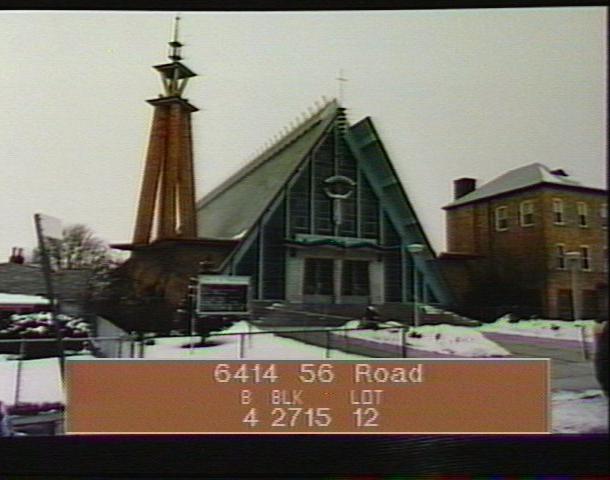
The city photographed every building for its tax records around 1940 and again in the 1980s. NYC Municipal Archives.
Written with AI from the source each entry cites, then fact-checked.
- 1908
Transfiguration parish is organized for Lithuanian immigrants in Maspeth and Blissville
The Transfiguration parish was organized in 1908 to serve the Lithuanian immigrants who had settled in Maspeth and in the Blissville section of Long Island City. Its first church, put up in 1909, stood on Hull Avenue rather than on this lot.
“Its parish was organized in 1908. ... The purpose of building it was to serve a community of Lithuanian immigrants who settled in Maspeth and the Blissville section of Long Island City.”
Source: Wikipedia
- 1935
Transfiguration builds a church on the old grounds of St. Stanislaus Kostka
Earlier buildings on this site: after Transfiguration's first church on Hull Avenue burned in 1925, the parish moved to the former grounds of St. Stanislaus Kostka's old church on Clinton Avenue, whose rear faced Perry Avenue, while St. Stanislaus moved to Maspeth Avenue and 61st Street. Transfiguration built a new church here in 1935, and that building later became the parish hall.
Source: Wikipedia
- 1962
Architect Jonas Mulokas completes Transfiguration's A-frame modernist church
The Lithuanian architect Jonas Mulokas designed the present church, with John Stankus as contractor; work started in 1956 and the church was consecrated in 1962. Its steeple echoes a Lithuanian roadside shrine, a replica of which stands in the front yard, and the interior is decorated in a manner drawn from Lithuanian folk art. Above the doors, the Lithuanian words Mano Namai Maldos Namai mean "My house is a house of prayer."
Source: Wikipedia
- 1962
The New York Times puts a photograph of Transfiguration Church on its front page
Mulokas's design won a prize from the American Society of Registered Architects and a letter of commendation from the Queens Chamber of Commerce, and on December 2, 1962, the New York Times ran a photograph of it on page one. In July 2025 Frampton Tolbert of Docomomo called it the signature work of Mulokas's career.
“…a photograph of the Lithuanian Church appeared on the front page of the New York Times on 2 December 1962…”
Source: Wikipedia
Further reading
Nearby
- Holy Cross Roman Catholic Church61-21 56th Road | 3 entries
- St. Stanislaus Kostka Church57-15 61st Street | 1 entry
- Knockdown Center52-19 Flushing Avenue | 2 entries
- Christ the King Regional High School68-02 Metropolitan Avenue | 5 entries
- St. Adalbert Roman Catholic Church52-29 83rd Street | 3 entries
- Cypress Hills Taxidermy Studio71-01 Metropolitan Avenue | 1 entry