64 Horatio Street
also 64A Horatio Street | West Village | built 1846
Open on the map5 entries

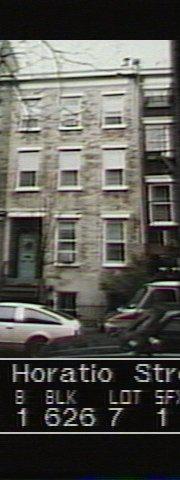
The city photographed every building for its tax records around 1940 and again in the 1980s. NYC Municipal Archives.
Written with AI from the source each entry cites, then fact-checked.
- 1846
Abraham Demarest builds No. 64 Horatio as one of five matching Greek Revival houses
No. 64 Horatio Street is one of five Greek Revival houses put up in 1845-46 on land the Ireland family owned until 1844. The Irelands sold the lots to two cartmen, who passed them to the neighborhood builder Abraham Demarest, whom the landmarks report credits with the row. The report names No. 64, with No. 58, as the best preserved of the five, and observes that its cornice blends with those of Nos. 58 to 62 and the corner house at 825 Greenwich Street into a unifying line along the top.
- 1856
A burning quilt sets fire to the back porch of Ann Redway's boarding house at 64 Horatio
By 1854 the widow Ann Redway ran No. 64 as a boarding house for professionals, among them a Pier 15 agent and an ironworks owner. On the morning of August 15, 1856, a quilt caught fire from a furnace on the back piazza and the flames spread to the porch. The New York Herald reported that the fire was put out quickly, at a loss of perhaps $3.
Source: Daytonian in Manhattan
- 1863
Pioneering Bleecker Street portrait photographer Jacob C. Banta boards at 64 Horatio with his family
Around 1863 the house took in Jacob C. Banta, his wife, Sarah, and their young daughter, Lillie, as boarders. Banta, born about 1832, was an early professional photographer who made posed cabinet cards at his studio on Bleecker Street, number 328. They shared the house with the family of Albert Anderson, who left in 1866.
Source: Daytonian in Manhattan
- 1932
Young Villagers rent two floors of 64 Horatio as a cooperative household
In 1932 David Jenkins, then 18, Muriel Reiker and the dancer and Art Students League model Gittel Poznoski Steed leased two floors for $60 a month and pooled their money. Jenkins recalled in 1988 that Steed introduced him to Village painters such as Raphael Soyer and Yasuo Kuniyoshi, and that he also met poets there.
Source: Daytonian in Manhattan
- 1934
The Daily Worker advertises a Workers School benefit house party at 64 Horatio Street
Steed and Jenkins soon became members of the Young Communist League, and the house served as a venue for meetings and gatherings. On May 26, 1934, the Communist newspaper The Daily Worker announced a house party at 64 Horatio that night for the Workers School's $1,000 drive, with dancing, games and refreshments for a 15-cent admission. A second benefit party for a labor group followed on September 7.
Source: Daytonian in Manhattan
Further reading
- The James McComb House - 64 Horatio StreetDaytonian in Manhattan
- Then & Now photos: 64 Horatio StreetVillage Preservation: Greenwich Village Then & Now
Nearby
- 66 Horatio Street2 entries
- 60 Horatio Street5 entries
- 58 Horatio Street3 entries
- 57 Horatio Street5 entries
- 59 Horatio Street5 entries
- 51 Horatio Street5 entries