Church of the Holy Communion (former Limelight)
656 Avenue of the Americas | also 652 Avenue of the Americas | Flatiron | built 1853
Open on the map13 entries

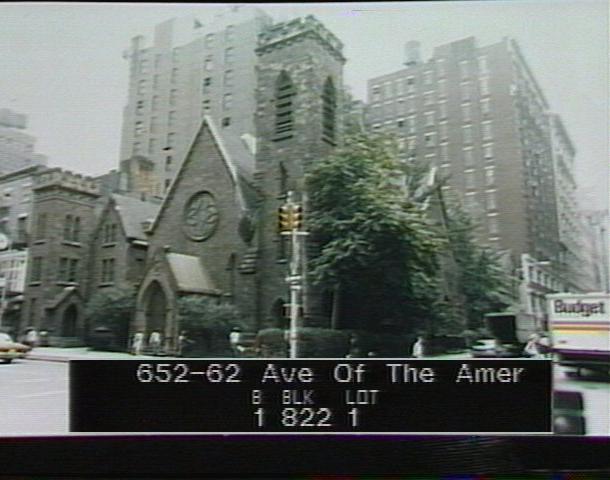
The city photographed every building for its tax records around 1940 and again in the 1980s. NYC Municipal Archives.
Written with AI from the source each entry cites, then fact-checked.
- 1846
Richard Upjohn's Church of the Holy Communion is consecrated
Built in 1844–45 for the Rev. William Muhlenberg, who saw the Gothic style as the true architecture of Christianity, the church was designed by Richard Upjohn and consecrated in 1846. It was the first asymmetrical Gothic Revival church in the United States and became one of the most influential buildings of its century. The city designated it a landmark in 1966.
Source: Wikipedia
- 1846
The Church of the Holy Communion is the city's first free church, with pews open to all
The Landmarks Preservation Commission's designation report calls the Church of the Holy Communion, begun in 1844 and completed in 1846 to designs by Richard Upjohn, the first free church in New York City, meaning its pews were open to all comers. The report also credits the church with introducing the first boy choir in the city.
“…the first free church, that is, the first church in the City in which the pews were free to all comers…”
- 1850
William Muhlenberg, rector of Holy Communion, sees his sisterhood's work lead to St. Luke's Hospital
William Augustus Muhlenberg became rector of the Church of the Holy Communion in 1846 and founded its Sisterhood, the first American order of Protestant Episcopal deaconesses. His work with the sisterhood led to the establishment of St. Luke's Hospital in 1850. His congregation had made offerings each St. Luke's Day since 1847. Muhlenberg died in 1877 at the hospital he founded.
“…led to the 1850 establishment of St. Luke's Hospital, for which his congregation made offerings each St. Luke's Day beginning in 1847.”
Source: Wikipedia
- 1854
The Sisterhood of the Holy Communion gets its own Sister's House
The church complex grew through the 1850s: a parish house and rectory were finished in 1853, and a Sister's House followed in 1854 to shelter the Sisterhood of the Holy Communion, an Episcopal order based at the church. The additions gave Holy Communion a full campus of parish buildings unusual for its time.
Source: Wikipedia
- 1966
The city designates the church complex a landmark, noting that St. Luke's Hospital began in the Sisters' House
On April 19, 1966, after a March 8 hearing at which four speakers favored designation, the Landmarks Preservation Commission designated the Church of the Holy Communion, Sisters' House and Chapel a landmark. The report cites the first free church, the first boys choir and the first Anglican sisterhood in the country. It also notes that the sisters founded St. Luke's Hospital in the Sisters' House, later moved to a large building on Fifth Avenue at 54th Street and now located at 113th Street and Amsterdam Avenue.
- 1976
The Lindisfarne Association makes the church a center for poetry readings, concerts and lectures
After the parish merged with two others, it leased the church to the Lindisfarne Association, which used it as headquarters from 1976 to 1979. Under founder William Irwin Thompson, it hosted poets such as Gary Snyder, Robert Bly and Wendell Berry, concerts by Paul Winter and David Hykes, and lectures by theater figures Jerzy Grotowski and Andre Gregory. Philosophers such as Gregory Bateson and Francisco Varela also gave lectures there.
Source: Wikipedia
- 1979
The Lindisfarne Association gives up the deconsecrated church
After the shrinking Holy Communion parish merged into Calvary-St. George's Church in 1975, it leased the deconsecrated building to the countercultural Lindisfarne Association, which turned it into a cultural center hosting lectures and readings by figures such as Gregory Bateson and Gary Snyder. Unable to raise money to restore the aging structure, Lindisfarne gave it up in 1979, and the parish sold it on to Odyssey House, a drug rehabilitation program, before it eventually passed to nightclub owner Peter Gatien's Limelight.
Source: Wikipedia
- 1983
Peter Gatien opens the Limelight nightclub in the deconsecrated church
After its parish merged with two others in the 1970s, the church was deconsecrated and sold to Odyssey House, a drug rehabilitation program. Club owner Peter Gatien bought it, spent close to $5 million on renovations and opened the Limelight in November 1983, with a dance floor under four-story ceilings. It became associated with the Club Kids and was later reused as a market and a gym.
Source: Wikipedia
- 1988
Peter Gatien hires club promoter Michael Alig, whose parties at the Limelight draw a crowd
In 1988, Limelight owner Peter Gatien hired the promoter Michael Alig, a ringleader of the Club Kids. His Limelight parties proved so popular that he soon began organizing events for other Gatien venues, including Club USA, the Palladium and Tunnel. Years later, in March 1996, Alig and his roommate killed fellow Club Kid Angel Melendez, who had worked at the Limelight, and Alig pleaded guilty to manslaughter in 1997.
“In 1988, Alig was hired by Peter Gatien, the owner of The Limelight. Alig's parties at The Limelight were such a hit…”
Source: Wikipedia
- 1995
Police raid the Limelight but find only three small marijuana dealers, and the club closes for a week
In October 1995 the New York Police Department raided the Limelight. Officers made only three small arrests of marijuana dealers, because owner Peter Gatien had been tipped off. The club then stayed closed for seven days; Gatien paid a $30,000 fine and put up a $160,000 bond.
“In October 1995, the club was raided by the New York Police Department. They were only able to make three small arrests of marijuana dealers…”
Source: Wikipedia
- 2009
A pop-up discount boutique fills the empty ex-Limelight church after two years of vacancy
By February 2009 the Gothic Revival church had sat empty for two years. Fashion retailer Jack Menashe, who had lost the lease on his Soho boutique, used it for a temporary store of purportedly discounted designer clothes, pop artworks and plush furniture. The New York Observer found a DJ playing on the stage and nostalgia drawing customers, while landlord Ben Ashkenazy was still weighing what to do with the building.
Source: Internet Archive
- 2010
The old church reopens as a three-story shopping destination for artisanal brands
In 2010, the former Limelight became a three-story shopping destination for artisanal brands. The New York Post later said the venture lasted only a few years. The building then passed through a nightclub-themed gym, a French bistro and a series of pop-ups, and more recent plans aimed to turn the church into a performance space.
Source: nypost.com
- 2025
Big for-sale and for-lease signs go up on the vacant Limelight church
In August 2025 the New York Post reported huge for-sale and for-lease signs outside the deconsecrated church at 20th Street and Sixth Avenue. Employees said the main sanctuary was vacant, while the building's edges held Limelight Pizza NYC and the dim sum restaurant Jue Lan Club. City records listed Mansion Realty LLC, tied to Ben Ashkenazy's real estate firm, as owner of the whole parcel.
Source: nypost.com
Further reading
Nearby
- O'Neill Building655 Avenue of the Americas | 3 entries
- Adams & Co. Building675 Avenue of the Americas | 3 entries
- Siegel-Cooper Building620 Avenue of the Americas | 3 entries
- Ladies Mile Historic District18 West 20th Street | 3 entries
- Adorama building45 West 17th Street | 7 entries
- Masonic Hall716 Avenue of the Americas | 8 entries