The New School
66 West 12th Street | Greenwich Village | built 1931
Open on the map10 entries

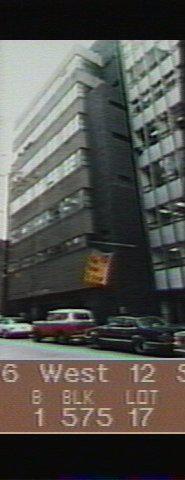
The city photographed every building for its tax records around 1940 and again in the 1980s. NYC Municipal Archives.
Written with AI from the source each entry cites, then fact-checked.
- 1929
The Mayer family gives $100,000 and brings in its own construction firm to build the New School's new home
The Landmarks Preservation Commission's biography of Clara Mayer, a longtime New School administrator, records that her family gave $100,000 toward the school's new building on West 12th Street, constructed in 1929-31 to Joseph Urban's design. Her brothers' firm, J.H. Taylor Construction Co., was brought in to build it economically, and brothers Charles and Albert Mayer are credited with suggesting Urban as architect. The auditorium was first dedicated to their father, Bernhard Mayer.
- 1931
Joseph Urban completes the New School's building on West 12th Street
The New School had spent its first years in converted townhouses on West 23rd Street, which were slated for demolition in 1928 to make way for London Terrace. Its new building, designed by Joseph Urban and completed in 1931 at a cost of about $1,000,000, rose on the site of three donated houses and an adjoining lot. The school's history project describes it as the first building in the International Style in New York City.
Source: histories.newschool.edu
- 1931
José Clemente Orozco paints murals for the new building
Orozco painted his frescoes while the building was still under construction, with 47 days to finish the project. He, Thomas Hart Benton and Camilo Egas painted walls of the building without pay. The Orozco and Egas works remain at the New School, while Benton's murals are now displayed at the Metropolitan Museum of Art.
Source: histories.newschool.edu
- 1931
Thomas Hart Benton paints the mural cycle "America Today"
Alongside José Clemente Orozco's murals for the same building, the New School commissions Thomas Hart Benton to paint "America Today," a cycle depicting American industry, labor, and daily life. The two commissions make Joseph Urban's new building on West 12th Street an early showcase for socially engaged American mural painting.
Source: Wikipedia
- 1940
Erwin Piscator's Dramatic Workshop starts staging productions in the Studio Theatre at 66 West 12th Street
Alvin Johnson, the New School's president, signed an agreement in spring 1939 with the exiled German director Erwin Piscator to found a drama school, and the Dramatic Workshop began classes in January 1940 with about 20 students. That September it started giving semi-professional productions in its Studio Theatre, the Tishman Auditorium of this building. Its faculty included Stella Adler and Lee Strasberg, and its students later included Marlon Brando, Tennessee Williams and Elaine Stritch.
Source: Wikipedia
- 1944
The Dramatic Workshop closes its Studio Theatre and begins moving student shows off West 12th Street
The Studio Theatre in the New School auditorium had to close in 1944. After the war the G.I. Bill briefly made the Dramatic Workshop one of the country's largest drama schools, and in 1946 Piscator began shifting student shows to the Rooftop Theatre at 111 East Houston Street and the President Theatre at 247 West 48th Street. The workshop was separated from the New School in June 1949.
“Since the Studio Theatre had to be closed in 1944, Piscator successively started to transfer the student productions to the “President Theatre”…”
Source: Wikipedia
- 1960
The Jacob M. Kaplan Building opens as an addition that carries the school through to West 11th Street
Mayer, Whittlesey & Glass designed the Jacob M. Kaplan Building in 1955, and it opened in 1960 as an addition to Joseph Urban's school, reaching through the block to West 11th Street. The Landmarks Preservation Commission's 1969 district report describes a curtain-wall design that stresses vertical lines, with a revolving door and large plate-glass windows that let passersby see into the lobby and the courtyard beyond.
Source: media.villagepreservation.org
- 1969
The Greenwich Village Historic District report singles out the New School's striped brick front
The Landmarks Preservation Commission's 1969 designation report for the Greenwich Village Historic District treats the building as a standout. It describes a cantilevered brick front over a polished black-stone entrance to the auditorium, with alternating bands of light and dark brick that give the facade a striated look. The commission calls the design severe even for its day and says it set a new mode of horizontal expression that reappeared in many later office buildings.
Source: media.villagepreservation.org
- 1994
Inside the Actors Studio starts taping at the New School's Tishman Auditorium, with Paul Newman as first guest
The interview series began in 1994 as a collaboration between the Actors Studio and New School University, a televised seminar aimed at students of the Actors Studio's drama school. Paul Newman, a former Actors Studio president, was its first guest. Early episodes were taped in the New School's Tishman Auditorium, and the program soon became the flagship of the cable channel Bravo.
“At first taped at the New School's Tishman Auditorium in Greenwich Village, New York City…”
Source: Wikipedia
- 1997
The New School auditorium becomes an interior landmark
The city designated Joseph Urban's 500-seat auditorium at 66 West 12th Street an interior New York City landmark.
Source: Village Preservation
Further reading
- The New SchoolWikipedia
- Then & Now photos: New School for Social ResearchVillage Preservation: Greenwich Village Then & Now
Nearby
- Rev. Edwin R. T. Cook House62 West 12th Street | 4 entries
- 80 West 12th Street4 entries
- 59 West 12th Street3 entries
- Dr. Oliver White House52 West 12th Street | 4 entries
- 472 Avenue of the Americas1 entry
- 50 West 12th Street4 entries