Herring Building (the Triangle Building)
675 Hudson Street | also 26 9th Avenue, 355 West 13th Street, 24 9th Avenue | West Village | built 1849
Open on the map5 entries

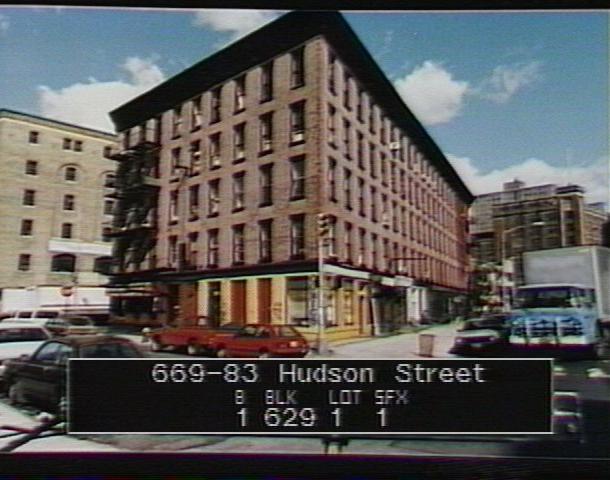
The city photographed every building for its tax records around 1940 and again in the 1980s. NYC Municipal Archives.
Written with AI from the source each entry cites, then fact-checked.
- 1849
Safe manufacturer Silas C. Herring buys the triangular lot at Ninth Avenue and builds a five-story factory
In 1849 Colonel Silas C. Herring bought the triangular lot where Hudson Street, Ninth Avenue and West 13th Street meet and put up a five-story factory for his safe business. Born in Vermont in 1803, he had lost a downtown grocery business in the fire of 1835, became the agent for Enos Wilder's Salamander fireproof safe in 1841, and bought the manufacturing rights in 1844. The New York Times later called him one of the country's foremost manufacturers.
- 1849
The Herring Building is the earliest surviving purpose-built industrial building from its district's first phase
The Landmarks Preservation Commission describes the Herring Building as a vernacular, neo-Grec factory dating from about 1849, with its northern section added by 1860. It calls the building the earliest surviving purpose-built industrial structure from the first phase of the Gansevoort Market district's development. Its triangular shape, three brick and stone facades and late-19th-century cornice stand out at a wide intersection, and it appeared in the film The Hours in 2002.
- 1895
Building owner Henry J. Newton, called the father of the dry-plate process, is killed by a Broadway streetcar
Henry J. Newton, a former piano maker who became a millionaire through New York real estate and headed the Henry-Bonnard Bronze Co., later bought the Herring Building. His photography experiments earned him credit as America's father of the dry-plate process. A Broadway streetcar hit and killed him in 1895; the building went into foreclosure in 1898 and passed to the estate of lawyer Stephen Philbin.
“Newton was struck and killed by a Broadway streetcar in 1895.”
- 1971
The Hellfire club and other gay clubs make the old safe factory a nightlife address for three decades
By the early 1970s the former factory was known for nightlife. The district report lists the Hellfire club there from 1971 to 2002, alongside gay clubs named Triangle, Barn, Attic, Sewer and J's Hangout. The Metropolitan Community Church of New York also appears among the tenants in 1980.
“Metropolitan Community Church of New York (1980); Triangle, Barn, Attic, Sewer, J's Hangout, gay clubs; Hellfire, club (1971-2002)…”
- 2005
A collapsed curbstone on Ninth Avenue reveals forgotten brick vaults reached from 675 Hudson's basement
Early in 2005 a curbstone on Ninth Avenue suddenly fell into a void, and workers entered the old brick-lined vaults beneath the street by way of the basement at 675 Hudson Street. The vaults predated the building by almost a decade and had been used for stabling horses and storing goods, and by one account a foundry, before being sealed around 1920. Owner Ari Ellis restored the arches and pillars and, with Matt Abramcyk, converted the space about 40 feet below Ninth Avenue into 675 Bar.
Source: Daytonian in Manhattan
Further reading
- The Forgotten Vaults Under No. 675 Hudson StreetDaytonian in Manhattan
Nearby
- 400 West 14th Street (37 Ninth Avenue)400 West 14th Street | 4 entries
- 29 9th Avenue3 entries
- Hotel Gansevoort18 9th Avenue | 2 entries
- 21 9th Avenue3 entries
- 408 West 14th Street1 entry
- Hudson Building345 West 13th Street | 5 entries