St. Ann & the Holy Trinity Church
68 Clinton Street | also 157 Montague Street | Brooklyn Heights | built 1847
Open on the map6 entries

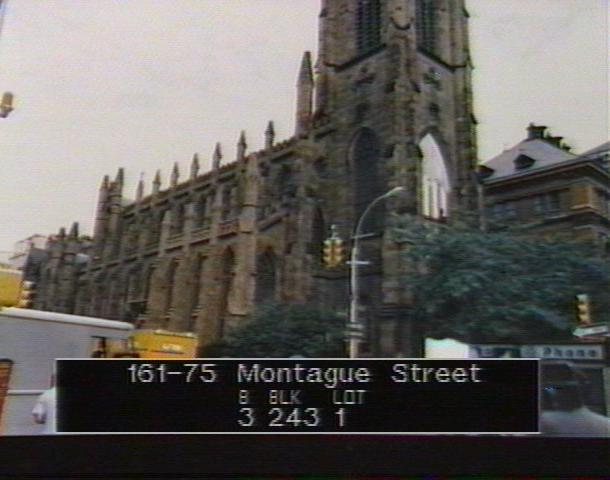
The city photographed every building for its tax records around 1940 and again in the 1980s. NYC Municipal Archives.
Written with AI from the source each entry cites, then fact-checked.
- 1847
Minard Lafever's Church of the Holy Trinity opens at Montague and Clinton streets
The Church of the Holy Trinity opened in 1847 on the northwest corner of Montague and Clinton streets in Brooklyn Heights. Minard Lafever, a leading American architect of the century, designed it, and the stained glass came from William Jay Bolton and his brother John Bolton. Today the Episcopal Diocese of Long Island counts it as its co-cathedral.
“The designer for Holy Trinity was prominent 19th-century American architect Minard Lafever, with stained glass by William Jay Bolton and John Bolton.”
Source: Wikipedia
- 1848
William Jay Bolton finishes the first full set of figural stained glass produced in North America
Between 1845 and 1848 William Jay Bolton, helped by his brother John, made the church's windows. They form the first complete set of figural stained glass windows produced in North America. The windows come in six distinct groups totaling 55 installations, and 54 of them survive.
Source: Wikipedia
- 1925
Financier George Foster Peabody gives the church an E.M. Skinner organ in memory of his brother
Parishioner and financier George Foster Peabody donated the Peabody Memorial Organ in memory of his brother. Ernest M. Skinner built it in 1925 as Opus 524, with 4,718 pipes, 20 chimes and a 61-note celesta. Virgil Fox and Louis Vierne, organist of Notre Dame in Paris, were among the famous players who performed on it in Brooklyn. It is the largest Skinner organ in the city.
“…it was a gift to the church from parishioner and financier George Foster Peabody in memory of his brother. It is the largest E.M. Skinner organ in New York City.”
Source: Wikipedia
- 1957
After years of controversy, the Holy Trinity parish is closed
The parish of Holy Trinity was closed in 1957 following years of controversy. The church building then stood mostly empty for the next twelve years, until another congregation moved in.
“Following years of controversy, the parish was closed in 1957. The building stood mostly empty for the next 12 years.”
Source: Wikipedia
- 1969
St. Ann's, Brooklyn's oldest Episcopal parish, moves into the empty Holy Trinity church
In 1969 the congregation of St. Ann's, organized in 1787 as the oldest Episcopal parish in Brooklyn, moved into the vacant Holy Trinity building. The combined name came from that move. Years of deferred maintenance meant the reopened building needed costly repairs, which started many conservation campaigns for the church and its endangered windows.
Source: Wikipedia
- 1979
The New York Landmarks Conservancy starts a restoration program for the church
In 1979 the New York Landmarks Conservancy launched a restoration effort for the church, known as the St. Ann Center for Restoration and Arts. Through that effort the chancel was renovated, 64 stained glass windows were restored and the exterior fence was repaired.
Source: Wikipedia
Further reading
- St. Ann & the Holy Trinity ChurchWikipedia
Nearby
- Brooklyn Historical Society (Center for Brooklyn History)128 Pierrepont Street | 6 entries
- People's Trust Company Building181 Montague Street | 9 entries
- Brooklyn Trust Company Building138 Pierrepont Street | 6 entries
- National Title Guaranty Company Building185 Montague Street | 9 entries
- Saint Ann's School129 Pierrepont Street | 3 entries
- First Unitarian Church121 Pierrepont Street | 2 entries