69th Regiment Armory
68 Lexington Avenue | also 60 Lexington Avenue | Gramercy | built 1906
Open on the map12 entries

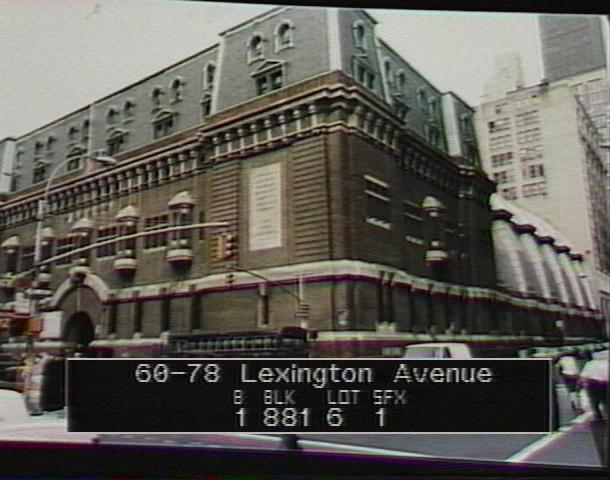
The city photographed every building for its tax records around 1940 and again in the 1980s. NYC Municipal Archives.
Written with AI from the source each entry cites, then fact-checked.
- 1904
Boarding-house tenants are ordered out of the condemned block to clear the armory site
The city condemned the buildings standing on the future armory site between 25th and 26th Streets, and letters dated January 16, 1904 told the residents to leave by February 15. Many of those buildings were boarding houses, and new rooms were hard to find. The Times reported the day after the deadline that some tenants were too ill to move and that one had died after catching cold while looking for another apartment.
Source: Daytonian in Manhattan
- 1904
The cornerstone is laid on the anniversary of a Civil War departure
The armory's cornerstone is set on April 23, the forty-third anniversary of the 69th Regiment marching off to fight in the Civil War. Architect Richard Howland Hunt of the firm Hunt & Hunt designs the building to look like a city armory rather than a medieval fortress, breaking from the castle-like style of earlier armories.
Source: Wikipedia
- 1906
The 69th Regiment Armory opens without the usual castle styling
Hunt & Hunt designed the armory in the Beaux-Arts style, and it was the first armory in New York City not modeled on a medieval fortress. The cornerstone was laid on April 23, 1904, and the building opened on October 13, 1906. It is still the headquarters of the 1st Battalion, 69th Infantry Regiment of the New York Army National Guard.
Source: Wikipedia
- 1910
Thure Johansson of Sweden breaks the indoor marathon record at the armory
On March 1, 1910, the Swedish runner Thure Johansson broke Dorando Pietri's indoor marathon record at the armory, finishing in 2 hours, 36 minutes and 55.2 seconds. The armory's early athletic calendar also included lawn-tennis matches, amateur boxing and badminton games.
“Thure Johansson of Sweden broke Dorando Pietri's indoor record for the marathon at the 69th Regiment Armory on March 1, 1910…”
Source: Wikipedia
- 1911
The armory hosts a Christmas Eve giveaway for 8,000 families
On Christmas Eve the drill hall hosts a charitable distribution of food and gifts to roughly 8,000 needy families, one of the large public events the Beaux-Arts building regularly accommodates in its early years alongside auto shows and pageants.
Source: Daytonian in Manhattan
- 1913
The Armory Show introduces modern European art to American crowds
From February 17 to March 17, 1913, the International Exhibition of Modern Art filled the drill hall with about 1,300 works, including pieces by Van Gogh, Picasso, Matisse and Marcel Duchamp. More than 100,000 people came, and the show is often described as the dawn of modernism in America. The armory became a city landmark in 1983.
Source: Wikipedia
- 1913
The Stockholm Gymnastic Society spends a week of exhibitions in the drill hall
In December 1913 the Stockholm Gymnastic Society gave a full week of exhibitions at the armory. Newspaper accounts said its calisthenic drills surpassed any seen in the country and that the Swedish gymnasts' leaps and handsprings over apparatus drew applause from the reviewing stand and the galleries.
Source: Daytonian in Manhattan
- 1919
An aeronautical exposition fills the drill hall with aircraft and trophies from France
With the war over, the Aeronautical Exposition of the Manufacturers' Aircraft Association held a two-week exhibition that opened at the armory on March 1, 1919. The drill hall held aircraft and the trophies American pilots had brought home from France, and the army, navy and post office departments helped assemble the displays. The Tribune's headline declared America supreme in the air.
Source: Daytonian in Manhattan
- 1946
The New York Knicks begin playing some home games in the drill hall
The armory's drill hall doubled as a sports arena. From 1946 to 1960 it was the site of some New York Knicks home games, including several games of the NBA Finals. It has also hosted athletic meets, expositions and fashion shows.
Source: Wikipedia
- 1948
Roller Derby comes to the drill hall, including the first matches shown on television
The armory hosted at least 17 Roller Derby matches between late 1948 and early 1949. Some of them were the first Roller Derby matches ever shown on television. During the same years, some New York Knicks home games were also played in the drill hall.
“From late 1948 to early 1949, the armory hosted at least 17 roller derby matches, including the first matches ever broadcast on television.”
Source: Wikipedia
- 1975
Giants and Jets players take part in a 48-hour basketball game billed as the world's longest
In 1975 the drill hall was the scene of what was then the world's longest basketball game, a 48-hour contest. The Giants and the Jets, two football teams, sent players to take on assorted other teams. The armory had been a frequent basketball venue through the mid-20th century, though a critic in 1967 called it close to being a fire trap.
“…the world's longest basketball game in 1975, a 48-hour competition pitting players from two football teams (the Giants and the Jets) against "sundry teams…”
Source: Wikipedia
- 2001
The armory becomes a bereavement center after 9/11
In the days after the September 11 attacks, the armory is converted into a bereavement center offering grief counseling and support to victims' families. It later returns to civilian use, again hosting exhibitions and events such as the Victoria's Secret Fashion Show.
Source: Wikipedia
Further reading
- 69th Regiment ArmoryWikipedia
- Hunt & Hunt's Monumental 69th Regiment Armory, 68 Lexington AveDaytonian in Manhattan
- 69th REGIMENT ARMORY, Lexington AvenueForgotten New York
Nearby
- Jazz Standard116 East 27th Street | 4 entries
- Hotel Giraffe365 Park Avenue South | 2 entries
- Gramercy Arts Theatre138 East 27th Street | 3 entries
- George Washington Hotel135 East 23rd Street | 12 entries
- Gramercy Theatre127 East 23rd Street | 8 entries
- Hotel Kenmore Hall145 East 23rd Street | 3 entries