Solomon Banta House
68 Perry Street | West Village | built 1867
Open on the map4 entries

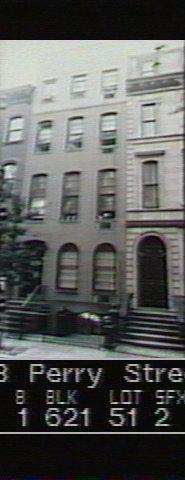
The city photographed every building for its tax records around 1940 and again in the 1980s. NYC Municipal Archives.
Written with AI from the source each entry cites, then fact-checked.
- 1867
Solomon Banta completes a Second Empire brownstone for his own family
Solomon Banta, a former alderman who owned a carriage works at 609 Hudson Street and built speculative housing in the Village, finished this brownstone home in 1867. Architect William Naugle gave it the new French Second Empire look, with round-headed parlor windows, an arched pediment over the doorway and a slate-shingled mansard top floor. Banta died the next year, and his funeral was held at the nearby True Dutch Reformed Church.
Source: Daytonian in Manhattan
- 1920
Newlyweds' separation suit follows an eleven-day marriage in the rooming house
By 1920 the house was a rooming house. Frank and Nancy Best moved in that January, and eleven days later she learned he was not the prosperous advertising man he had claimed and sued for separation. Two years later she had him arrested for disorderly conduct, and a magistrate dismissed the charge after her repeated outbursts in night court.
Source: Daytonian in Manhattan
- 1924
Newlyweds Isaiah and Nerma Oggins move in, later becoming Soviet spies
Isaiah "Cy" Oggins, a Columbia history graduate who joined a Communist party in 1923, and his bride Nerma Berman, an activist, moved here in 1924. Their friends included the anarchist Emma Goldman, who lived nearby on Grove Street. By 1926 they were recruited to spy abroad for the Soviet Union and went to Germany in 1928; Oggins never returned to the United States and was arrested in the Stalin purges.
Source: Daytonian in Manhattan
- 2000
A restoration begun in 2000 undoes the 1960 alterations
A 1960 renovation split the house into two apartments per floor and stripped its exterior: the entrance pediment and window lintels were removed, stucco covered the brownstone, and a flat-faced fourth floor and parapet replaced the mansard. A renovation begun in 2000 removed the stucco, restored the brownstone, added a period-appropriate cornice and rebuilt the stoop ironwork, lintels and entrance details.
Source: Daytonian in Manhattan
Further reading
- The 1867 Solomon Banta House - 68 Perry StreetDaytonian in Manhattan
- Then & Now photos: 68 Perry StreetVillage Preservation: Greenwich Village Then & Now
Nearby
- George F. Coddington Jr. House64 Perry Street | 4 entries
- Jeremiah Pangburn House76 Perry Street | 4 entries
- Henry Kloppenburg House78 Perry Street | 5 entries
- 67 Charles Street2 entries
- 65 Charles Street1 entry
- 61 Perry Street5 entries