William J. Cunningham House
681 Greenwich Street | West Village | built 1845
Open on the map5 entries

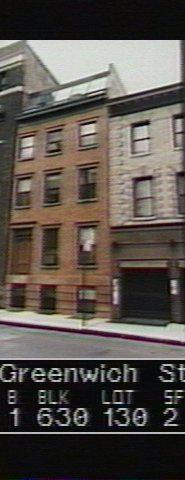
The city photographed every building for its tax records around 1940 and again in the 1980s. NYC Municipal Archives.
Written with AI from the source each entry cites, then fact-checked.
- 1845
Grocer Lewis Radford builds a row of seven houses, of which No. 681 is the survivor
Lewis Radford, a grocer, put up seven three-story brick houses with basements on the east side of Greenwich Street in 1845 as an investment, running north as far as No. 693. Number 681 is the only one left. The Landmarks Preservation Commission calls it very plain, noting the cornices over its windows and along the roof.
“Built in 1845 as an investment for Lewis Radford, grocer, this house is the sole survivor of what was once a row of seven three-story brick houses…”
- 1871
Dry goods merchant William J. Cunningham dies, with his funeral held in the parlor
The house became the home of William J. Cunningham, a dry goods merchant who traveled daily to his business at 23-25 Dey Street, and his wife, son and teenage brother-in-law N. W. Badeau Jr. Badeau died on February 5, 1862 at age 29 and was mourned at a funeral in the house two days later. Nine years afterward a second funeral took place in the parlor, following Cunningham's death on January 27, 1871.
Source: Daytonian in Manhattan
- 1873
The house becomes a boarding house, and a tenant's body is brought home after a pier accident
Within two years of Cunningham's death the house was a boarding house for white-collar tenants. One was Alexander Brinkerhoff, 26, bookkeeper for stone dealer John Green, whose yard stood at the foot of Jane Street. On October 24, 1873, as he supervised the hoisting of stone blocks at the pier, part of a derrick fell on his head and killed him; The New York Times reported that his body was taken to 681 Greenwich Street to await the inquest.
Source: Daytonian in Manhattan
- 1912
A sailor's landlady calls the police and an unidentified woman is found dead in his room
Catherine Bellew ran the house as a sailors' boarding house in 1912. When the locked room of her lodger Frederick Goulet, a French-born chef on an American Line steamship, drew no answer by 4 p.m. on Sunday, August 25, she called a policeman, who broke in and found a woman's body on the bed. Goulet said he had given her a bed for the night and found her dead in the morning; although The New York Times said she seemed to have died naturally, he was arrested pending an autopsy.
Source: Daytonian in Manhattan
- 1979
Architect Philip Teller buys the house at city auction and converts it to ten apartments
The stoop was removed around 1942 for the widening of Greenwich Street, and the entrance moved to the rear, reached through a Christopher Street courtyard. The Port Authority-Trans Hudson bought the house in 1962 for use as a workshop. The city put it up for auction in 1979, and Philip Teller, an architect and attorney, bought it and converted it into a ten-family building, keeping the floating front door at the insistence of the Landmarks Preservation Commission.
Source: Daytonian in Manhattan
Further reading
- The 1845 William J. Cunningham House - 681 Greenwich StreetDaytonian in Manhattan
- Then & Now photos: 681 Greenwich StreetVillage Preservation: Greenwich Village Then & Now
Nearby
- Hudson Tubes Christopher Street substation137 Christopher Street | 5 entries
- 679 Greenwich Street2 entries
- 135 Christopher Street3 entries
- Austen House133 Christopher Street | 5 entries
- Greenwich Mews687C Greenwich Street | 1 entry
- St. Luke's School657 Greenwich Street | 3 entries