Fleischmann Company building
695 Washington Street | also 699 Washington Street, 146 Perry Street | West Village | built 1911
Open on the map5 entries

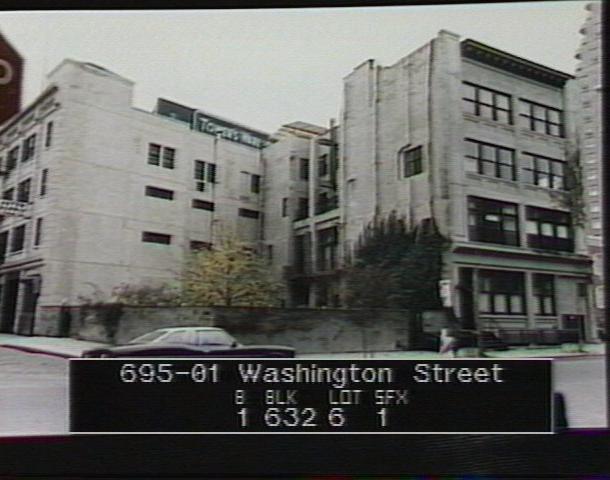
The city photographed every building for its tax records around 1940 and again in the 1980s. NYC Municipal Archives.
Written with AI from the source each entry cites, then fact-checked.
- 1888
The Fleischmann brothers build their New York yeast office on the corner of this lot
Charles and Maximilian Fleischmann, Austrian-born distillers and yeast makers based in Cincinnati, acquired land at Washington and Perry Streets, on the southeast corner, in 1883-84. Maximilian had moved to New York to run their East Coast business. On the corner part of what is now this building's lot, at No. 701 Washington Street, they built an office building designed by Theodore G. Stein in 1887-88; the New York Times in 1897 called it the headquarters of the yeast business. It was demolished between about 1964 and 1988, and the corner is now a courtyard.
“No. 701 Washington Street (1887-88, Theodore G. Stein, architect; demolished c. 1964-88, the site today is the corner courtyard)…”
- 1911
The Fleischmann Company raises a reinforced-concrete factory, and adds two floors in 1921
Read more
In 1910-11 the Fleischmann Company built the first two floors of this concrete-and-brick factory, to a design by Arthur M. Duncan, after putting up its Perry Street stables in 1908-09. The firm moved its national headquarters here in 1919. In 1921 two more floors were added by C. Aubrey Jackson, the company's real estate manager, working with Louis L. Tieman.
- 1929
J.P. Morgan folds Fleischmann into the $430 million Standard Brands merger
In 1929 J.P. Morgan and Company chose the Fleischmann Company, prized for its fleets of delivery wagons and trucks, as the centerpiece of a food-industry consolidation. The $430 million merger created Standard Brands, which also took in Royal Baking Powder, Gillett and Chase and Sanborn coffee. This building became its Manhattan agency, New York division office and order department, and Standard Brands kept it until 1944.
“With the $430 million dollar merger, the new holding company was named Standard Brands, Inc., which also included the Royal Baking Powder Co.”
- 1945
An importer of Italian sweets and bitters occupies the factory until it goes bankrupt in 1961
Enrico Fucini and Company, also styled Alemagna Confections, owned and used the building from 1945 to 1961. It imported Italian foods, confections and stomachic bitters until the firm went bankrupt. Architect Peter Franzese converted the former factory into apartments in 1978.
“…owned and used from 1945 to 1961 by E[nrico]. Fucini & Co./ Alemagna Confections, importer of Italian foods, confections, and stomachic bitters; the firm went bankrupt in 1961.”
- 1966
A cargo-handling tenant with Genovese family connections faces a license suspension
From about 1964 to 1968 the building housed Erb Strapping, which inspected, warehoused and repackaged goods bound for ships. It handled much of the meat imported through the Port of New York for government inspection. The company was investigated over connections to the Genovese crime family, and Michael Genovese was then its vice president. In 1966 the city moved to suspend its cart license, and in 1968 a court upheld the Waterfront Commission's right to investigate whether it was acting as a stevedore.
“…the company came under investigation due to its connections with the Genovese organized crime family since 1955 (Michael Genovese was then vice president of the Erb company).”
Nearby
- 693 Washington Street1 entry
- 140 Perry Street4 entries
- 689 Washington Street1 entry
- 139 Charles Street1 entry
- Le Gendarme (former Ninth Precinct station house)135 Charles Street | 5 entries
- 136 Perry Street3 entries