Port Arthur Restaurant building
7 Mott Street | also 9 Mott Street | Chinatown | built 1920
Open on the map6 entries

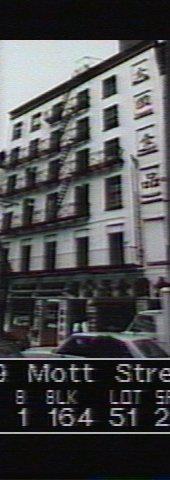
The city photographed every building for its tax records around 1940 and again in the 1980s. NYC Municipal Archives.
Written with AI from the source each entry cites, then fact-checked.
- 1885
A six-story mattress and bedding factory stands at 9 Mott Street by 1885
By 1885 or earlier, the brick building at 9 Mott Street, six stories tall and six bays wide with brownstone lintels, was in use as a mattress and bedding factory. The National Register nomination for the Chinatown and Little Italy district lists it in the Italianate commercial mode. The same structure later became known as the home of the Port Arthur Restaurant, which the nomination calls infamous.
Source: National Register nomination
- 1897
Chu Gam Fai opens the Port Arthur Restaurant, the first in Chinatown with a liquor license
Port Arthur opened in 1897 at 7-9 Mott Street, founded by Chu Gam Fai and named for a port city in northern China. It occupied the second and third floors, with general dining on the second and the third reserved for banquets and weddings. The Museum of Chinese in America records that it was the first Chinatown restaurant to win a liquor license, and that its rooms were furnished with inlaid mahogany tables, lanterns, chandeliers and Cantonese teakwood furniture.
Source: mocanyc.org
- 1906
Tom Lee reportedly celebrates the tong peace treaty at the Port Arthur Restaurant
In 1906 Warren W. Foster, a judge of the Court of General Sessions, helped Tom Lee, head of the On Leong Tong and often called the Mayor of Chinatown, and the Hip Sing Tong's leaders sign a treaty after years of conflict. Lee reportedly marked the occasion with 107 mugs of rice wine at Port Arthur on Mott Street. By 1909 the peace had soured.
“After the treaty, Lee reportedly drank 107 mugs of rice wine at the Port Arthur Restaurant of Mott Street to celebrate.”
Source: Wikipedia
- 1909
The manager of Port Arthur is found with Elsie Sigel's letters after her murder
Elsie Sigel, a 19-year-old missionary, was found strangled in a trunk on June 18, 1909. It was speculated that jealousy lay behind the killing, because Chu Gain, who managed Port Arthur on Mott Street, held recent love letters from her. Chu said he had received an anonymous letter threatening her life. The prime suspect, Leon Ling, was never apprehended, and the case set off a wave of anti-Chinese hysteria.
“Chu Gain, manager of the Port Arthur Restaurant on Mott Street, was also found to be in possession of recent love letters from Sigel.”
Source: Wikipedia
- 1938
Port Arthur head chef Henry Low publishes a cookbook with an early egg roll recipe
Henry Low, head chef at Port Arthur on Mott Street during the 1920s and 1930s, published Cook at Home in Chinese with Macmillan in 1938. The book includes an egg roll recipe he called Tchun Guen, and it is credited with popularizing American Chinese recipes. Low is one of two New York chefs who may have invented the egg roll in the 1920s, the other being Lum Fong.
“In 1938, he published the cookbook Cook at Home in Chinese through Macmillan Publishers, which includes a recipe for egg rolls which he called "Tchun Guen".”
Source: Wikipedia
- 1944
Chinatown Fair opens in the ground floor of the Port Arthur building
Chinatown Fair opened in 1944 on the first floor of the Port Arthur building at 7-9 Mott Street, where the exporters Soy Kee & Co. and the Eastern Trading Company had previously been. It began as a penny arcade and small museum, with a dancing chicken among its first attractions, and became a video game arcade in the 1970s. Sam Palmer bought it in 1982, and in 1991 it shifted its focus to competitive fighting games.
Source: Wikipedia
Nearby
- Eng Suey Sun Association5 Mott Street | 1 entry
- 11 Mott Street1 entry
- 3 Mott Street1 entry
- Moo Tie Temple and Chinatown post office13 Mott Street | 1 entry
- 1 Mott Street1 entry
- True Light Lutheran Church195 Worth Street | 5 entries