New York Jewelers Exchange
70 Bowery | also 72 Bowery | Little Italy | built 1920
Open on the map3 entries

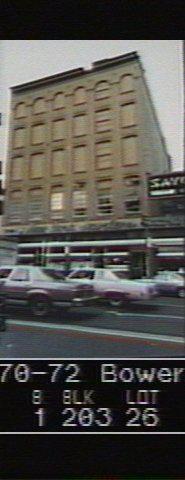
The city photographed every building for its tax records around 1940 and again in the 1980s. NYC Municipal Archives.
Written with AI from the source each entry cites, then fact-checked.
- 1858
Henry Astor develops a Second Empire building at 70 Bowery
The Bowery Historic District nomination dates the original 70 Bowery to 1858 and says Henry Astor developed it. It was a Second Empire building whose mansard roof was later removed. The facade now sits under brown stucco and pink granite, refaced in 1988 and again in 1996, which hides the 1858 building beneath.
Source: National Register nomination
- 1896
Firuski & Son auctioneers keep offices at 70 Bowery while the building also serves as the Uncas House lodging house
The Bowery Historic District nomination lists 70-72 Bowery as the Uncas House, a lodging house, in the 1890s and again in 1921. In 1896 it also records the offices of Firuski & Son, auctioneers of 85 Bowery, at 70 Bowery.
“Offices of Firuski & Son, Auctioneers, of 85 Bowery, 1896. Nos. 70-72 Uncas House, lodging house, 1890s; 1921.”
Source: National Register nomination
- 1922
Eugene Rosenbaum runs a pawn shop and auction house at 70 Bowery as late as 1922
Eugene Rosenbaum operated a pawn shop and auction house at 70 Bowery, and the Bowery Historic District nomination places him there as late as 1922. The nomination describes the Bowery's late-nineteenth-century auction houses and pawnshops, including the fake auctions that swindled out-of-town buyers, and says how many were legitimate, if any, is unknown.
“70 Bowery was pawn shop and auction house of Eugene Rosenbaum as late as 1922…”
Source: National Register nomination
Nearby
- New York Jewelers Exchange74 Bowery | 1 entry
- Gulden's Mustard factory40 Elizabeth Street | 1 entry
- 78 Bowery1 entry
- Lighthouse Preschool80 Bowery | 2 entries
- 54 Elizabeth Street1 entry
- Royal Jewelry Center84 Bowery | 1 entry