70 Mulberry Street
also 74 Mulberry Street, 86 Bayard Street | Chinatown | built 1900
Open on the map5 entries

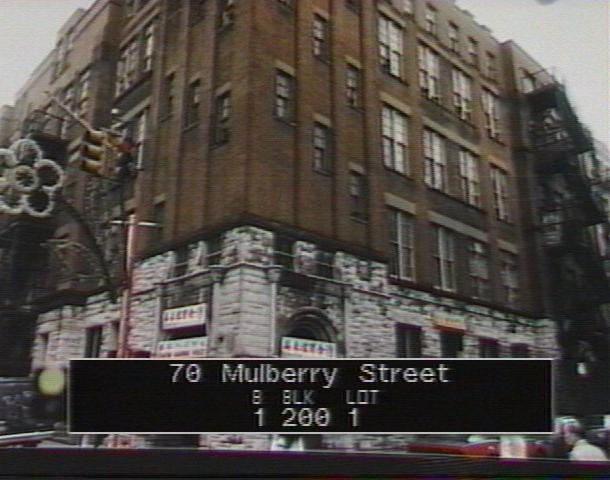
The city photographed every building for its tax records around 1940 and again in the 1980s. NYC Municipal Archives.
Written with AI from the source each entry cites, then fact-checked.
- 1891
The city files plans for Public School 23 on Mulberry Street
In 1891 the city filed plans for this school, designed by Charles B. J. Snyder with 31 classrooms for up to 1,694 pupils at a cost of $130,000. As P.S. 23 it was renamed the Columbus School in 1915, reflecting the then mostly Italian American neighborhood, and by the 1930s more of its pupils were Chinese. It closed as a school in June 1976 and became home to community groups.
Source: archives.nyc
- 1892
PS 23 opens as a showcase of fireproof school design
Architect C. B. J. Snyder completed PS 23 in 1892, his first New York City school commission, combining Romanesque and Renaissance Revival styles with an orange brick facade and a tower of stair-stepped windows. The Evening World called its fireproof ground floor, built with no combustible materials, one of the greatest advances yet made in school design, and Snyder gave the school a basement auditorium meant to double as a neighborhood gathering hall.
Source: Daytonian in Manhattan
- 1905
The New-York Tribune calls PS 23 the "school of twenty-nine nationalities"
By 1905 PS 23 was educating children of 29 nationalities, according to the New-York Tribune, drawn from the crowded Five Points tenements and including Italian, Irish, Polish, Russian, Greek, and Syrian families. The school also stayed open into the evening so pupils who worked during the day could still attend classes.
Source: Daytonian in Manhattan
- 1980
The former school becomes the Chinatown History Project
After the school closed, the building was converted in 1980 into the Chinatown History Project, renamed the Chinatown History Museum in 1991. The Chinatown Senior Center later moved in as well, and the school's upper tower was removed and replaced with a full story finished in sympathetic crenellated detail.
Source: Daytonian in Manhattan
- 2020
A five-alarm fire guts the Chinatown community hub at 70 Mulberry
A five-alarm fire on January 23, 2020, gutted the building, then home to groups including the Chinatown Manpower Project, the Chinese-American Planning Council, the Chen Dance Center and the collections of the Museum of Chinese in America. The third through fifth floors were demolished, leaving the brownstone base, brick second story and stair tower. In 2021 the city committed $170 million to rebuild behind the historic facade.
Source: 6sqft
Further reading
- C. B. J. Snyder's Innovative PS 23 -- 70 Mulberry StreetDaytonian in Manhattan
Nearby
- First tenement, 65 Mott Street65 Mott Street | 2 entries
- 65 Mott Street2 entries
- Columbus Park comfort station95 Bayard Street | 4 entries
- 69 Bayard restaurant building69 Bayard Street | 1 entry
- Chinese Consolidated Benevolent Association Building60A Mott Street | 4 entries
- 7 Elizabeth Street1 entry