Harriot house
705 Greenwich Street | West Village | built 1828
Open on the map5 entries

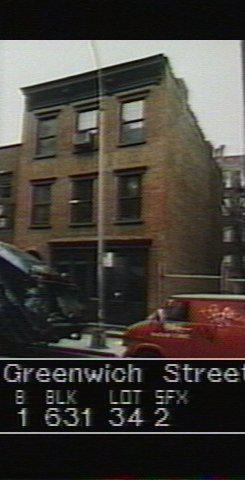
The city photographed every building for its tax records around 1940 and again in the 1980s. NYC Municipal Archives.
Written with AI from the source each entry cites, then fact-checked.
- 1828
Grocers W. and J. B. Harriot build two Federal houses, Nos. 703 and 705
The wholesale grocers W. and J. B. Harriot, whose store stood across the street, built Nos. 703 and 705 Greenwich Street in 1828 with Flemish bond brick fronts. Number 703, for the druggist Benjamin Quackenbush, combined shop and home; it has since been demolished. The handsome arched doorway at the left of No. 705, with two fluted Doric columns and a semicircular fanlight, is the main trace of the original design; the upper floors were added in the mid-nineteenth century.
“These two Federal houses were built in 1828 with fronts executed in Flemish bond brickwork. This house was built for W. and J. B. Harriot, wholesale grocers across the street…”
- 1856
A resident wins a bronze medal for wax fruit at the American Institute fair
Mrs. Nott, who lived in the house in 1856, entered her hand-made wax fruit in the Needlework, Embroidery and Fancy Articles category at the annual exhibition of the American Institute of New York City. She won first prize and a bronze medal. Two years later another resident, Matilda Vesey, taught at Primary School No. 11 on Greenwich Street.
Source: Daytonian in Manhattan
- 1861
William S. Wood, who lives here, resigns as Commissioner of Public Buildings
William S. Wood bought the house and made it his home. Lincoln re-appointed him Commissioner of Public Buildings in 1861, but on September 7 the New York Herald reported that he had resigned, saying he could not hold office while meeting the demands of those who claimed to control his department. He also volunteered as a firefighter and took a post as a city special inspector, and was discharged on December 8, 1864 in a legislative housecleaning.
Source: Daytonian in Manhattan
- 1871
Builder Nicholas Hemerich buys the house and turns its storefront into a vehicle opening
Florent Feltz sold the house on February 28, 1871 to the builder Nicholas Hemerich for $16,000. A broad elliptical arch replaced the storefront and held Hemerich's vehicles and supplies until about 1898; his yearly permit for trucks cost $180 by 1891. The arched brickwork of his shop can still be seen.
Source: Daytonian in Manhattan
- 2008
Donna Karan's Urban Zen boutique opens in the ground-floor store
A new corporation bought the building in 1940 and converted it to one apartment per upper floor with a remodeled store below, and a renovation in 1982 updated the storefront. In 2008 Donna Karan's Urban Zen boutique opened in that space, which Daytonian in Manhattan cites as evidence of how much the neighborhood had improved from its gritty Depression-era state.
Source: Daytonian in Manhattan
Further reading
- The 1828 House and Store at 705 Greenwich StreetDaytonian in Manhattan
- Then & Now photos: 707-711 Greenwich StreetVillage Preservation: Greenwich Village Then & Now
Nearby
- 711 Greenwich Street1 entry
- 697 Greenwich Street2 entries
- 257 West 10th Street4 entries
- 120 Charles Street1 entry
- 716 Greenwich Street2 entries
- 714 Greenwich Street1 entry