The King of Greene Street
72 Greene Street | also 76 Greene Street | SoHo | built 1873
Open on the map6 entries

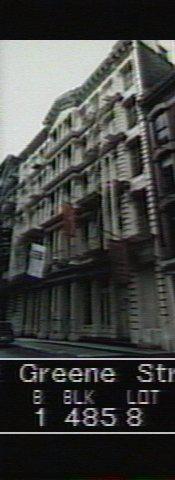
The city photographed every building for its tax records around 1940 and again in the 1980s. NYC Municipal Archives.
Written with AI from the source each entry cites, then fact-checked.
- 1872
Boston merchant Gardner Colby buys the lots and has Isaac Duckworth build a 'commercial palace'
On May 27, 1872 architect Isaac F. Duckworth sold numbers 72 and 74 Greene Street to Gardner A. Colby of Boston for $72,000, days after Colby bought no. 76. Colby, 62, had built a dry-goods firm in the 1850s, filled Civil War uniform contracts and presided over the Wisconsin Central Railroad. Construction began August 8, 1872 and ended April 30, 1873.
Source: Daytonian in Manhattan
- 1884
Silk wholesaler Edward Haas, dogged by a fraud case, goes blind and is paralyzed within weeks
Edward Haas had been arrested on federal fraud charges in 1877 and settled with the government in 1881 for $15,000. He moved into the Greene Street building hoping for a fresh start. In late June 1884 his sight began to fail, and on July 20 the New York Times reported him completely blind and paralyzed, expected to live only a little longer.
Source: Daytonian in Manhattan
- 1889
Cap makers strike Solomon Simonson and three strikers are arrested over a non-union worker
When Solomon Simonson refused a raise, 60 cap makers walked out in the first week of January 1889. Three strikers visited a colleague who kept working, Adolph Gletzenstein, at his Ludlow Street home, and The Sun reported on January 10 that they used threats and blows. They were arrested for conspiracy and assault, and said that he had chased them out at gunpoint.
Source: Daytonian in Manhattan
- 1893
A Stern & Schloss partner dies in the Long Island Rail Road collision near Long Island City
J. Mortimer Dittman, 30, a partner in the infant-wear makers Stern & Schloss, was returning from a visit to his sister when his train collided near Long Island City with a special from Manhattan Beach on the night of August 26, 1893. The Sun called it the worst railroad disaster in Long Island history. Dittman died at the scene, and a letter and a check found in his coat pocket identified him.
Source: Daytonian in Manhattan
- 1924
Burglars break into Philip Nathan & Co. with tools and explosives and take $8,429 in underwear
On the night of June 18, 1924, thieves broke into the third-floor premises of Philip Nathan & Co., a cotton underwear maker, using tools and explosives. They left with $8,429.49 in merchandise, about $117,000 in 2015 money. The apparel trade was already moving uptown, and by 1934 the Artistic Doll Corp. had taken the space.
Source: Daytonian in Manhattan
- 2012
A $41.5 million sale leads to the restoration of 'The King of Greene Street'
When the building changed hands in 2012 for $41.5 million, its ornate cast-iron front had already won it the nickname The King of Greene Street. The buyers, L3 Capital and ASB Capital, hired McKay Architecture/Design to restore it. The finished building rises seven stories, as Duckworth had planned, with a modern two-story penthouse set back out of sight where his mansard would have stood.
Source: Daytonian in Manhattan
Further reading
- The King of Greene Street -- Nos. 72-76 Greene St.Daytonian in Manhattan
Nearby
- 78 Greene Street4 entries
- 70 Greene Street4 entries
- 68 Greene Street1 entry
- 80 Greene Street1 entry
- 66 Greene Street1 entry
- 85 Mercer Street1 entry