73 Bedford Street
West Village | built 1836
Open on the map4 entries

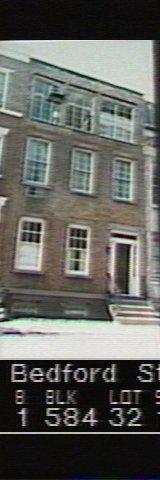
The city photographed every building for its tax records around 1940 and again in the 1980s. NYC Municipal Archives.
Written with AI from the source each entry cites, then fact-checked.
- 1836
Charles Oakley builds 73 Bedford on leased Hendricks-Gomez land
Number 73 and its twin at 75 went up in 1836 for Charles Oakley, who leased the ground from the Hendricks-Gomez estate and had been developing Greenwich Village since the mid-1820s. The Greek Revival house was later stuccoed above the second story, its doorway converted to a floor-length window and its entrance moved around to Commerce Street. Wide casement windows now fill the third floor.
- 1859
Gershom Seixas Nathan and Rosalie Gomez Nathan move into 73 Bedford, on land her family owned
The Gomez family still owned the ground under the house. In 1853 Rosalie Gomez married Gershom Seixas Nathan, whose father Simon had backed the American Revolution and served as a trustee of Shearith Israel, and in 1859 the couple moved in. They had seven children. Gershom died on July 12, 1864, aged 42, and Rosalie later moved to West 87th Street.
Source: Daytonian in Manhattan
- 1896
A dying laundry owner at 73 Bedford is anointed with a relic of St. Anthony and recovers
Terrence H. Forrest, who leased the house in the 1890s and ran a laundry on the East Side, had suffered from dropsy for years. In spring 1896 Father McCabe, from St. Anthony of Padua church, came to give last rites and anointed him with a relic of the saint in a gold case. The World reported on June 4 that Forrest rallied almost at once and his family said he was well again, though neither he nor the priest would discuss it.
Source: Daytonian in Manhattan
- 1923
Villagers buy 73-77 Bedford for a community art center, and Ferdinand Savignano remodels the houses
In October 1923 the Gomez family began selling about a dozen properties, including 73 through 77 Bedford. On November 18 the New York Times announced a new community art center on Bedford and Commerce Streets, formed by artists, writers and performers who had bought the houses. Architect Ferdinand Savignano raised the attic of No. 73 to a full floor made mostly of glass for studio space. Seven years later, the widening of Bedford Street took the stoop.
Source: Daytonian in Manhattan
Further reading
- The Gershom Nathan House - 73 Bedford StreetDaytonian in Manhattan
- Then & Now photos: 73 Bedford StreetVillage Preservation: Greenwich Village Then & Now
Nearby
- 75 Bedford Street4 entries
- 71 Bedford Street1 entry
- 75½ Bedford Street75 1/2 Bedford Street | 9 entries
- 69 Bedford Street4 entries
- Isaacs-Hendricks House77 Bedford Street | 5 entries
- Diana Traphagen House67 Bedford Street | 5 entries