73 East Houston Street
also 77 East Houston Street | Nolita | built 1900
Open on the map4 entries

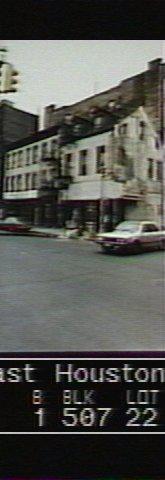
The city photographed every building for its tax records around 1940 and again in the 1980s. NYC Municipal Archives.
Written with AI from the source each entry cites, then fact-checked.
- 1871
A horse-and-wagon business and a Victorian brothel share a Federal corner house
Built in the 1820s as part of a row of Federal-style working-class houses with shops at street level, 73 East Houston Street sits on the corner of Elizabeth Street. In 1870 D. Haase and F. Koster ran a horse and wagon business here, and Emma Everett ran a brothel upstairs with five boarders. An 1871 guide to vice in the city described it as a quiet, orderly place that took clients by appointment.
Source: Daytonian in Manhattan
- 1895
Neighborhood children send lemonade-stand money to a newspaper's Sick Babies' Fund
By the 1890s Irish immigrants filled the neighborhood, and families likely lived above the shops. In summer 1895 three children, Tommy Moroney, 5, Marion Tighe, 10, and Annie Sullivan, 11, ran a lemonade stand in front of the house. They sent the $2.25 they raised to The Evening World's Sick Babies' Fund, which paid for steamboat outings for sick tenement children, and the paper printed their note on August 26.
Source: Daytonian in Manhattan
- 1920
Vincenzo Cascale, owner of La Bella Palermo pastry shop, buys the row at Nos. 73 to 79
Landlord Howard Conkling owned the whole row at Nos. 73 to 79 and signed new leases for each house in March 1908. In October 1920 he sold all of it to Vincenzo Cascale, by which time No. 73 was the last original house left. Cascale was well known in the local Italian community for his pastry shop, La Bella Palermo, which operated for decades.
Source: Daytonian in Manhattan
- 1930
Houston Street is widened, but the little corner house survives
In 1930, during the Depression, hundreds of out-of-work men found jobs on a project to widen Houston Street into a broad thoroughfare. Across the street from No. 73, hundreds of buildings about a century old were torn down, but this one survived. By 1944 it held two apartments per floor, and it still stands among newer buildings, though the upper stories have been stuccoed over.
Source: Daytonian in Manhattan
Further reading
- The Federal Survivor at No. 73 East Houston StreetDaytonian in Manhattan
Nearby
- 260 Elizabeth Street1 entry
- 276 Bowery3 entries
- 265 Elizabeth Street7 entries
- 288 Elizabeth Street4 entries
- 290 Elizabeth Street3 entries
- 292 Elizabeth Street2 entries