Kreischerville Workers' Houses, 71-73 Kreischer Street
73 Kreischer Street | also 71 Kreischer Street | Charleston | built 1920
Open on the map5 entries

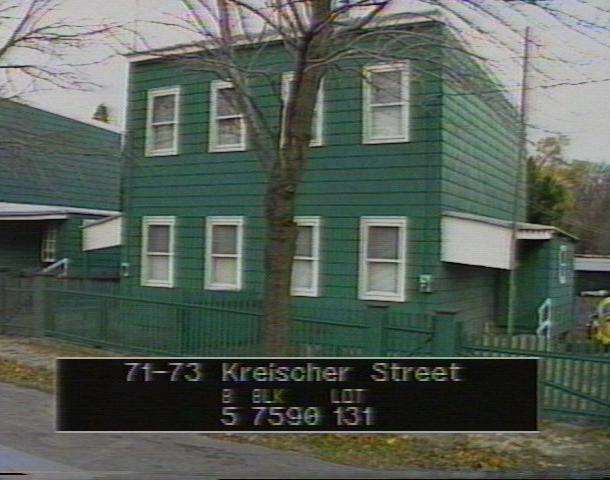
The city photographed every building for its tax records around 1940 and again in the 1980s. NYC Municipal Archives.
Written with AI from the source each entry cites, then fact-checked.
- 1890
Peter Androvette builds a shingled double house for the village's workers
Around 1890 Peter Androvette had this two-story, wood-framed double house put up as one of four matching pairs on the east side of Kreischer Street. The shingle-clad halves were entered through porches on the side walls, and the two households shared one outhouse behind the house. Across the street stood a nearly identical row of double houses built by the Kreischer firm.
“Around 1890 the double house at 71-73 Kreischer Street, along with three identical structures, was erected for Peter Androvette.”
- 1900
A German clay-works laborer and a German cigar maker split the house in 1900
The 1900 federal census found Charles Kube, a German-born day laborer at the clay works, living in No. 71 with his wife, his father-in-law and two boarders who were day laborers too. The other half, No. 73, was home to Peter Wust, a cigar manufacturer who had also come from Germany. Who first lived in the house when it was new is not known.
“In 1900 Charles Kube, a German immigrant and day laborer at the clay works, resided in No. 71 with his wife, two boarders…”
- 1920
Hungarian and Romanian immigrants take over both halves of the house by 1920
By 1910 a Hungarian saloon keeper, J. Deak, had moved into No. 71, and in 1920 that half held hotel proprietor Louis Sabo, also from Hungary, with his wife and sons; the eldest was a cable winder at the dental works. At No. 73 the census listed Jacob Mazwrek, a Romanian presser at the terra-cotta works, in 1910, and apparently the family of Hungarian John Szeles, a Tottenville Copper Co. worker, in 1920.
“Hotel proprietor Louis Sabo (a Hungarian immigrant) lived in No. 71 in 1920 with his wife and sons…”
- 1923
Janos Szucs buys all four Kreischer Street double houses after Androvette dies
After Peter Androvette's death, the land beneath all four double houses went in 1923 to Janos (John) Szucs, who lived nearby in Green Ridge. By the 1930s Szucs seems to have settled into No. 71 himself. When he died in 1967 the houses went to his heirs, and Mary Belansky became the owner of Nos. 71-73.
“…the property on which all four of the double houses stand was sold in 1923 to Janos (John) Szucs of nearby Green Ridge…”
- 1994
The city makes 71-73 Kreischer Street a landmark despite its owners' objections
The Landmarks Preservation Commission designated the double house a city landmark on July 26, 1994, following a hearing held October 1, 1991. The Staten Island Historical Society and several preservation groups testified in favor, while Borough President Guy Molinari and Councilman Alfred C. Cerullo III had reservations. Owners Irene and Mary Belansky opposed individual designation under the existing zoning, backed by the Charleston Civic Association and Community Board 3.
“Irene Belansky, who with Mary Belansky, owns the Kreischer Street houses, expressed opposition to individual designation with the existing zoning…”
Nearby
- Kreischerville Workers' Houses, 75-77 Kreischer Street75 Kreischer Street | 4 entries
- Kreischerville Workers' Houses, 85-87 Kreischer Street85 Kreischer Street | 4 entries
- Kreischer House4500 Arthur Kill Road | 6 entries
- Staten Island Pavilion3080 Arthur Kill Road | 2 entries