David Ramsey House
737 Washington Street | West Village | built 1845
Open on the map5 entries

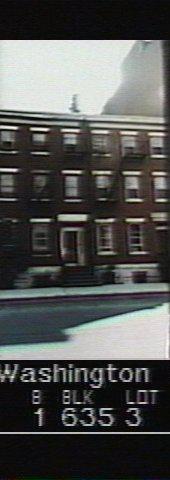
The city photographed every building for its tax records around 1940 and again in the 1980s. NYC Municipal Archives.
Written with AI from the source each entry cites, then fact-checked.
- 1845
Carman David Ramsey and grocer Charles Crane build four matching houses, and Ramsey takes No. 737 for his family
In 1844 Charles Crane partnered with David Ramsey, a wagon driver, to build four matching homes at 733-739 Washington Street, completed in 1845. They were three stories of red brick over English basements, with Greek Revival entrances. Ramsey's household shared No. 737 with another carman and with a boatman who repaired boats on the nearby waterfront.
Source: Daytonian in Manhattan
- 1887
A Belgian glove maker who forged 90,000 francs is arrested after hiding in the basement for 18 months
Almi De Schempfeleere ran a glove business in Belgium until money trouble led him to forgery. He fled to New York with Eugenie Copenello and their two children in December 1885, and took basement rooms here while doing piecework for a Broadway glove maker. After the Belgian government traced him to New York, detectives watched the house for some time, noting how rarely the family went out, and he was arrested on June 29, 1887 as he bought bread at a nearby grocery.
Source: Daytonian in Manhattan
- 1894
A teenager from the house is arrested after gangs fire pistols near Bank and Bethune Streets
Thomas Kennedy, 15, whose father owned the house, belonged to the Dumpers gang. For a week gangs of boys had faced off near Bank and Bethune Streets, and on February 22, 1894 the fighting escalated to thrown missiles and small pistols, with one boy stabbed and another shot. Kennedy was seen firing a handgun and was caught when someone shouted a warning and the rest scattered. At the stationhouse he said he had not meant to kill anyone.
Source: Daytonian in Manhattan
- 1911
Police search for four-year-old Agnes Quigg and find her sticky with candy, having followed a snow shoveler
On March 5, 1911 Mary Quigg rushed to the Charles Street police station when her daughter Agnes, who lived here, went missing. A witness had seen the girl on Bank Street with a roughly dressed man carrying a shovel. A detective found her at Tenth and Bleecker Streets enjoying a candy stick, with a tangled head of hair and a sugar-stained face. The man with the shovel was a snow shoveler she had tagged along behind.
Source: Daytonian in Manhattan
- 1950
Printmaker Stanley William Hayter works on a large print in his top-floor studio here
Hayter, born in England in 1901, founded the printmaking studio Atelier 17 in Paris in 1927, then moved to New York when the war began and started a New York branch while teaching at the New School. In a 1950 Art News article, Ruthven Todd described him at work in his top-floor studio here on Marionette, an unusually large print. Hayter returned to Paris in 1950.
Source: Daytonian in Manhattan
Further reading
- The 1845 David Ramsey House - 737 Washington StreetDaytonian in Manhattan
- Then & Now photos: 737 Washington StreetVillage Preservation: Greenwich Village Then & Now
Nearby
- Jacob A. Conover House735 Washington Street | 4 entries
- 131 Bank Street2 entries
- Charles C. Crane House129 Bank Street | 3 entries
- 123 Bank Street1 entry
- 132 Bank Street2 entries
- 134 Bank Street1 entry