74 Laight Street
also 413 Washington Street | Tribeca | built 1900
Open on the map3 entries

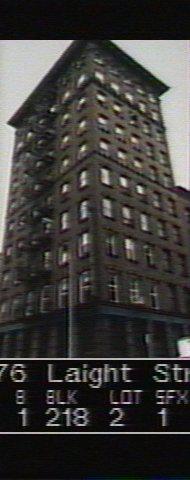
The city photographed every building for its tax records around 1940 and again in the 1980s. NYC Municipal Archives.
Written with AI from the source each entry cites, then fact-checked.
- 1899
Thomas R. Jackson finishes James Pyle's block with a ten-story steel-framed warehouse at 74-76 Laight Street
Built in 1899-1900, this warehouse was the last of five buildings that Thomas R. Jackson designed for soap manufacturer James Pyle on the block, and four of the five still stand. It rises ten stories, with a 42-foot front on Laight Street and 60 feet on Washington Street. Its top two floors form an arcade of round-arched windows with terra-cotta capitals, under a deep copper cornice.
“Erected in 1899-1900, it is the last of five buildings on this block designed by Thomas R. Jackson, an architect who worked extensively in the Tribeca area, for soap manufacturer James Pyle…”
- 1900
Fairchild Brothers & Foster, makers of "digestive ferments," occupy 74-76 Laight Street into the 1940s
From its completion until the 1940s the warehouse housed the pharmaceutical firm Fairchild Brothers & Foster, whose products included digestive ferments. The company also used the neighboring building at 70-72 Laight Street. By the 1950s food processors and other businesses were running manufacturing lofts here.
“Upon completion and through the 1940s, the building was occupied by the pharmaceutical firm of Fairchild Brothers & Foster whose product line featured "digestive ferments.”
- 1970
The Laight Street warehouse becomes residential in the 1970s
The warehouse had served as manufacturing lofts for food processors and other businesses in the 1950s. It was converted to residential use in the 1970s, as the Landmarks Preservation Commission's Tribeca North Historic District report records.
“…was converted to residential use in the 1970s…”
Nearby
- 70 Laight Street2 entries
- 415 Washington Street2 entries
- 424 Greenwich Street2 entries
- 426 Greenwich Street2 entries
- 428 Greenwich Street2 entries
- James Pyle building430 Greenwich Street | 3 entries