Scott-Edwards House
752 Delafield Avenue | Port Richmond | built 1750
Open on the map5 entries

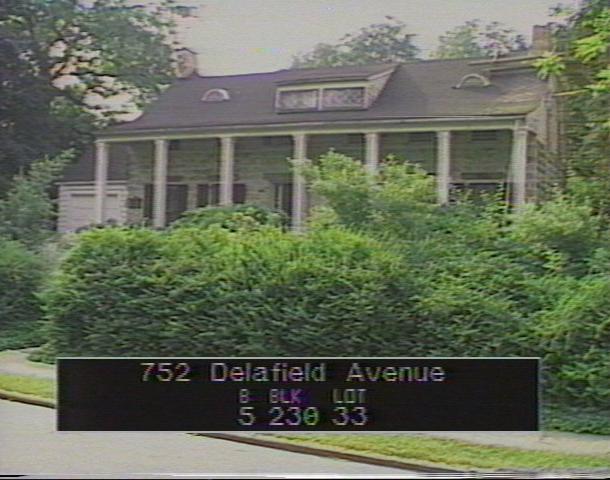
The city photographed every building for its tax records around 1940 and again in the 1980s. NYC Municipal Archives.
Written with AI from the source each entry cites, then fact-checked.
- 1730
A sandstone-and-clapboard house goes up on land from the 1677 Dongan grant
The house was built around 1730 on a parcel of the 1677 Governor Dongan grant, land that later passed to the governor's nephew. It was a story-and-a-half Dutch Colonial dwelling with a ground floor of bold sandstone ashlar and clapboard above, over a stone basement. No clear owner is recorded for the Revolutionary years, and the landmark report suggests it was then a tenant house on the Dongan estate.
“The Scott-Edwards House was built on a parcel of the old Governor Dongan grant of 1677.”
- 1840
Judge Ogden Edwards, a cousin of Aaron Burr, makes the house his home
Judge Ogden Edwards, a descendant of Jonathan Edwards and a cousin of Aaron Burr, lived here from 1840 to 1850. He was later appointed a justice of the New York Supreme Court, the first to come from Staten Island. The Landmarks Preservation Commission named the house's tie to a significant past owner among its reasons for designating it.
- 1840
A Greek Revival remodeling adds a seven-column veranda under a sweeping roof
Around 1840 the old Dutch Colonial house was remodeled in the Greek Revival style. A portico was added in which seven box columns carry the long, curving roof, forming a veranda across the whole front. Tall double-hung windows got paneled shutters, a row of low attic windows sits beneath the eaves, and a rear bay window holds English tinted glass believed to be more than 200 years old.
“The long, graceful sweep of the roof is supported by seven box columns forming a spacious veranda extending the width of the facade.”
- 1881
Florist Adam Scott buys the house, later followed by a Bronx botanical garden worker
Adam Scott, a florist, owned the house from 1881 to 1892. It afterward passed to Samuel Henshaw, an employee of the Bronx Botanical Gardens. The landmark report credits Henshaw with much of the skilled planting of shrubs that sets off the house on its landscaped grounds.
“From 1881 to 1892 the House was owned by Adam Scott, a florist.”
- 1967
The city designates the Scott-Edwards House a landmark, to its owners' delight
The Landmarks Preservation Commission designated the house after a September 13, 1966, hearing at which two witnesses spoke in favor and nobody opposed it. In a letter, the owners told the commission they were "proud and pleased." The commission praised the way the house joins Dutch Colonial features with the long, springing eave typical of Staten Island.
“Two witnesses spoke in favor of designation. There were no speakers in opposition to designation…”
Further reading
- Scott-Edwards HouseWikipedia
Nearby
- Church of the Blessed Sacrament30 Manor Road | 1 entry
- Mark W. Allen House665 Clove Road | 4 entries
- Temple Emanu-El984 Post Avenue | 2 entries
- Church of the Sacred Heart981 Castleton Avenue | 1 entry
- 29 Cottage Place4 entries
- Public School 20 Annex160 Heberton Avenue | 5 entries