William Burrell House
76 Bank Street | West Village | built 1840
Open on the map5 entries

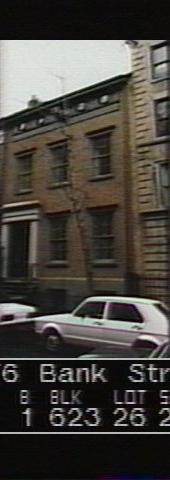
The city photographed every building for its tax records around 1940 and again in the 1980s. NYC Municipal Archives.
Written with AI from the source each entry cites, then fact-checked.
- 1840
Lockwood and his partners finish 76 Bank Street first in a row of four Greek Revival houses
Builder Andrew Lockwood bought the lots in 1835 and joined mason Amos Woodruff and the carpenters Baldwin & Mills to put up Nos. 70-76 between 1839 and 1842. Number 76 went up first, in 1839-40, and when the Landmarks Commission surveyed the block in 1969 it described the house as "in mint condition."
“No. 76 was built first, from 1839 to 1840 ... similar in appearance to No. 76, which is in mint condition…”
- 1842
Druggist William Burrell moves into 76 Bank Street in 1842
The new house was sold to a pharmacist named William Burrell, who moved in during 1842. The sources do not say how long his family stayed, and the house changed hands several times in the following decades.
Source: Daytonian in Manhattan
- 1878
Fireman Henry Springsteen, a former volunteer, moves his family into 76 Bank Street
Henry Springsteen was a carpenter who volunteered with the Guardian Engine Company in 1855 and became a professional fireman when the city created a paid department in 1865. By 1878 his family lived at 76 Bank Street, and he earned $100.92 a month, a figure unchanged in 1883. After his death in 1889 his widow received $1,000 in city death benefits.
Source: Daytonian in Manhattan
- 1917
Artist Virginia Hale lives at 76 Bank Street and shows with the Society of Independent Artists
By 1917 the house was either leased out or run as a boarding house, and one resident was the artist Virginia Hale. That year she exhibited at the Society of Independent Artists, at a time when Greenwich Village had become the city's bohemian center.
Source: Daytonian in Manhattan
- 1938
Writer John Cheever, then an editor on the WPA Guide to New York City, lives at 76 Bank Street
John Cheever lived in the house in the late 1930s, around the time he got a job editing for the Federal Writers' Project's guide to the city in 1938. He moved out when he married in 1941. In 1942 the house was converted into apartments, with a duplex on the lower floors and two flats on each floor above.
Source: Daytonian in Manhattan
Further reading
- The 1842 Wm. Burrell House -- No. 76 Bank StreetDaytonian in Manhattan
- Then & Now photos: 76 Bank StreetVillage Preservation: Greenwich Village Then & Now
Nearby
- 74 Bank Street5 entries
- 78 Bank Street1 entry
- 72 Bank Street2 entries
- 70 Bank Street5 entries
- Laux Hotel417 Bleecker Street | 2 entries
- 68 Bank Street5 entries