76 Wooster Street
SoHo | built 1871
Open on the map6 entries

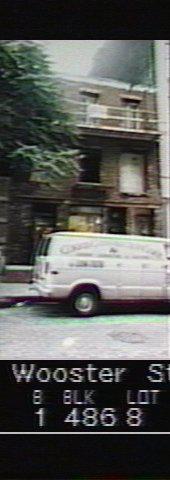
The city photographed every building for its tax records around 1940 and again in the 1980s. NYC Municipal Archives.
Written with AI from the source each entry cites, then fact-checked.
- 1871
Henry Fernbach, co-architect of Temple Emanu-El, converts a small house into a plain commercial building
M. & S. Sternberger, developers who often hired Henry Fernbach, had No. 76 Wooster Street remade into a store. Builder Sam Cochran began on June 5, 1871 and finished in under three months. The attic became a full story, and the first-floor piers were plain brick instead of cast iron. Fernbach co-designed Temple Emanu-El on Fifth Avenue, completed in 1868, and designed Central Synagogue a year after this job.
Source: Daytonian in Manhattan
- 1891
A nearly blind Civil War veteran leaves two savings books as loan security at a carpenter's shop and is never seen again
Carpenter Daniel Tyrrel leased this building in 1886. On October 31, 1891 his former employee John Sweeney, a wounded Union veteran with failing eyesight who sold pencils on the street, came to the shop and handed over two bank books showing nearly $1,000 as security for a $10 loan. He left for a saloon with Tyrrel's son, and the Times reported in 1900 that no trace of him had been found. In 1903 the courts ruled for the bank, saying there was no proof of his death.
Source: Daytonian in Manhattan
- 1905
Heirs sue over a millionaire's gift of this building, claiming psychic coercion by the daughter of his late friend
No. 76 Wooster Street was among properties worth about $1 million that Pierre Lorillard Ronalds deeded to Elizabeth Blake, the daughter of a friend who died while visiting him. After he died in 1905, his children sued, claiming he was coerced by her telling him the gift was the command of his dead relatives. The case ended with the properties returned to the heirs and a $200,000 trust for Blake.
Source: Daytonian in Manhattan
- 1986
Grace Jones prepares to open La Vie en Rose here, with one Warhol portrait of her on the wall
After a nouvelle-American restaurant called Wings in the early 1980s, the ground floor became La Vie en Rose, a restaurant run by Grace Jones. Its spare dining room had a single artwork on the wall, Andy Warhol's portrait of Jones. In September 1986, as the opening neared, her partner Jean-Yves Lascombes promised a chic underground.
Source: Daytonian in Manhattan
- 2011
Yoko Ono stages an exhibit of John Lennon's artwork and songs in the Wooster Street space
In October 2011 Yoko Ono borrowed 76 Wooster Street for "Gimme Some Truth, The Artwork of John Lennon," a show of Lennon's artworks and songs. By then the ground-floor space had become an art venue, once visited by Andy Warhol and Keith Haring, as well as Jean-Michel Basquiat and Julian Schnabel, in the stretch when SoHo was synonymous with contemporary art.
Source: Daytonian in Manhattan
- 2014
The Soho Arts Club opens at 76 Wooster, aiming to bring back the spirit of Warhol's old hideaway
In August 2014 artist Harif Guzman, who first set up his home and studio at the address, joined developer Golan Marom to launch the Soho Arts Club with the events group BABEL. Whitewall described the building as once Warhol's hideaway, where Basquiat, Haring and Schnabel hung out. The club offers 2,500 square feet over two floors with 22-foot ceilings for shows and workshops.
Source: whitewall.art
Further reading
- From Horses to Grace Jones and Andy Warhol--76 Wooster StreetDaytonian in Manhattan
Nearby
- Archer & Pancoast Factory74 Wooster Street | 1 entry
- 80 Wooster Street (Fluxhouse Cooperative II)80 Wooster Street | 6 entries
- 70 Wooster Street1 entry
- 69 Greene Street1 entry
- 67 Greene Street2 entries
- 71 Greene Street1 entry