77 Water Street
Financial District | built 1969
Open on the map7 entries

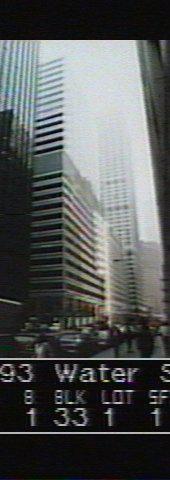
The city photographed every building for its tax records around 1940 and again in the 1980s. NYC Municipal Archives.
Written with AI from the source each entry cites, then fact-checked.
- 1969
Designer Rudolph de Harak and sculptor William Tarr create a Sopwith Camel replica for the roof
For the William Kaufman Organization's new 26-story tower, designer Rudolph de Harak and sculptor William Tarr produce a replica of the British Sopwith Camel fighter of 1916. It is put together at street level in 1969, then lifted by crane to the roof, where it is parked on artificial turf beside landing lights and a wind sock. The owners reasoned that taller neighbors would rather look down on a plane than on air-conditioning equipment.
Source: 6sqft
- 1970
Officials hold up the temporary occupancy certificate over the rooftop plane's runway
As construction neared its end, architect Richard Roth Jr. was told the tower could not get a temporary certificate of occupancy: an open runway on a roof was illegal, and the plane's strip still looked like one, number and all. Roth argued the plane was not real and suggested marking the runway with a cross to show it was out of use. The building commissioner agreed, saying that a plan showing an X would earn the certificate. Whether an X was ever painted on the roof is unclear.
Source: Untapped New York
- 1970
A second truck driver talks a night watchman into handing over the plaza's new trees
In Richard Roth Jr.'s telling, nearly 60 trees meant to soften the plaza arrived on a Friday evening after everyone had gone home, leaving only a night watchman. A second truck then pulled up, and its driver said thirty of the trees were diseased and had to go back; some of the newly delivered trees were loaded on, and the watchman signed a paper. On Monday people asked where the trees were. The thieves were never traced.
Source: Untapped New York
- 1970
Emery Roth & Sons designs the tower with a glass-and-steel skin and an entrance open to the weather
Richard Roth Jr. of Emery Roth & Sons designed the 26-story office building, his second project for developer Mel Kaufman, with a minimalist glass-and-steel skin. Kaufman disliked marble and granite lobbies and wanted a space open to the elements. Asked what would happen in winter, he proposed revolving doors that could be shifted in or out with the seasons. After September 11, part of the lobby area had to be enclosed.
Source: Untapped New York
- 1970
A turn-of-the-century-style penny candy shop and commissioned sculptures soften the new tower
The owners wanted to humanize the building, so they add a replica of an old penny candy store, with signs for real old-time brands and a striped awning. The building also incorporates honey locust trees, streams and footbridges, along with public art in the plaza and lobby, including Pamela Waters's school of metal fish on river rocks, William Tarr's sculpture Rejected Skin and George Adamy's playful benches, Month of June.
Source: 6sqft
- 2012
Developer Melvyn Kaufman, who topped 77 Water Street with a replica warplane, dies at 87
Melvyn Kaufman, who spent decades as an executive at the William Kaufman Organization, dies at his home in Mamaroneck, New York. He had built several Financial District towers, including 77 Water Street, where a full-size model of a World War I biplane stands on a lighted runway so tenants of surrounding towers would not have to look down on water tanks and air-conditioning systems. His obituary credits him with bringing whimsy to the city's office towers, a vision he realized with designers such as Pamela Waters and Rudolph de Harak.
Source: bostonglobe.com
- 2025
Vanbarton converts the tower to apartments and the rooftop Sopwith Camel comes down
By September 2025 the building is being converted into roughly 650 rental apartments by its owner, Vanbarton. The rooftop plane model has been taken apart, and the lobby candy store has closed, its operator now running a convenience store elsewhere. Vanbarton says it looked into saving or reusing both but found them too deteriorated to restore.
Source: Untapped New York
Further reading
- What’s a warplane doing on this office tower?Ephemeral New York
Nearby
- One Financial Square32 Old Slip | 9 entries
- First Precinct Police Station100 Old Slip | 6 entries
- Andaz Hotel Wall Street75 Wall Street | 3 entries
- Beaver Building82 Beaver Street | 11 entries
- 55 Water Street10 entries
- India House1 Hanover Square | 12 entries