McBurney House
79 Greene Street | SoHo | built 1838
Open on the map5 entries

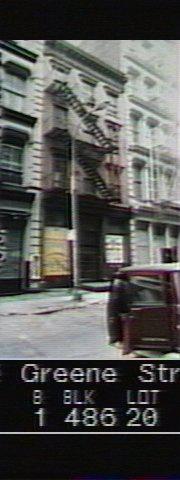
The city photographed every building for its tax records around 1940 and again in the 1980s. NYC Municipal Archives.
Written with AI from the source each entry cites, then fact-checked.
- 1846
The McBurney house on Greene Street is ordered sold at auction after a tangle of debts and lawsuits
Alexander McBurney built the three-and-a-half-story brick house in 1838, but his firm ran into financial trouble and he took out two mortgages on it. Shortly before dying in 1842 he transferred it to his mother, who had lent him money. His bankrupt brother Thomas had meanwhile sold his supposed interest in the property to Gordon Burnham, and the muddle of claims landed everyone in court. The judges ordered the house sold at auction on March 4, 1846, and it kept operating as a boarding house.
Source: Daytonian in Manhattan
- 1868
A court witness calls 79 Greene Street a brothel as the street becomes the city's red-light district
By the Civil War's end, Greene Street was becoming Manhattan's most notorious red-light district. Nicholas Betting ran 79 Greene as a boarding house, but in October 1867 an officer arrested a man seen carrying a trunk up Spring Street and found the house had been forced open and the trunk stolen from it. In 1868 witness Patrick Goff described it in court as a common bawdy house, and by 1871 Betting held a liquor license for it.
Source: Daytonian in Manhattan
- 1874
Hat maker Robert White turns the old house into an Italianate loft for the millinery trade
As commerce displaced the neighborhood's vice trade, hat maker Robert White bought the house and had architect J. F. Duckworth file plans in November 1874 to add a story and a rear extension. The result was an Italianate commercial building with a cast-iron storefront and cornice, with no sign of the old Federal house. White's tenants included his own hat factory and several other hatters.
Source: Daytonian in Manhattan
- 1875
Hat firm Gore, Sparrow & Co. offers $250, no questions asked, after a burglary
Gore, Sparrow & Co., hat makers on an upper floor, had barely moved in when thieves hit them on the night of January 18, 1875. On February 5 the firm ran a notice in the New York Herald offering $250 for the return of the stolen goods, with no questions asked. The partners were Calvin and Carlos Gore and David D. Sparrow.
Source: Daytonian in Manhattan
- 1902
A deputy marshal arrests clothier Max Hurbich in his office for a diamond-smuggling conspiracy
Clothier Max Hurbich had an office here when Deputy U.S. Marshal McAveny arrested him on July 15, 1902. He was accused of conspiring to smuggle diamonds. Hurbich had just come back from Detroit, where he testified against Louis Bush, who was charged with smuggling 181 unset diamonds, and that testimony had helped convict Bush. Now Hurbich himself was charged as an accomplice.
Source: Daytonian in Manhattan
Further reading
- The Altered 1838 Alexander McBurney House - 79 Greene StreetDaytonian in Manhattan
Nearby
- 77 Greene Street2 entries
- 81 Greene Street1 entry
- 75 Greene Street1 entry
- 83 Greene Street3 entries
- 71 Greene Street1 entry
- Albert Wagner Building84 Wooster Street | 5 entries