79 Pearl Street
also 46 Stone Street | Financial District | built 1836
Open on the map4 entries

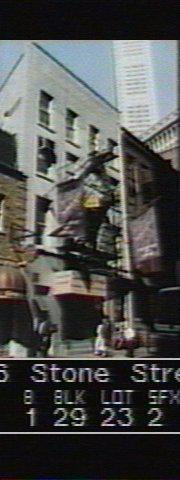
The city photographed every building for its tax records around 1940 and again in the 1980s. NYC Municipal Archives.
Written with AI from the source each entry cites, then fact-checked.
- 1835
The firm Stephens, Corlies & Denison occupies the earlier building at 79 Pearl Street at the time of the 1835 fire
By the time of the 1835 fire, John L. Stephens owned 79 Pearl Street, and the firm Stephens, Corlies & Denison was its occupant. Jacob H. Corlies lived next door at 46 Stone Street. After the fire John V. Greenfield bought the lot and put up the present building. This entry describes an earlier building on the site.
- 1836
A new Greek Revival store and loft building at 79 Pearl Street is occupied by dry-goods dealers by the end of 1836
John V. Greenfield built this store and loft building as one of three on adjoining lots after the 1835 fire. It was finished by the end of 1836 and occupied by Jackson & Deuel, a dry-goods firm. At mid-century the crockery business of Thompson & Lyon leased it. In the 20th century it served for storing and repairing office furniture and then as an eating and drinking place.
- 1939
Emily Carow, sister of Edith Roosevelt and associated with this building as an owner, dies
The Landmarks Commission names several notable people tied to 79 Pearl Street as property owners. Businessman Robert Kermit and steel merchant Charles Carow were partners in Kermit & Carow. Carow's daughters were Edith, who became Theodore Roosevelt's second wife, and Emily T. Carow (1865/66-1939), who lived for many years in Italy and led hospital work among soldiers there during World War I.
- 1986
Owner Ralph Catuoco has architect Joseph Feingold restore the building's partly removed top story in 1986-88
The top story of the 1836 building had been partly removed at mid-century. Owner Ralph Catuoco brought in architect Joseph Feingold in 1986-88 to rebuild the missing part, and the lower two floors held an eating and drinking place while apartments went into the upper two. The line between old and restored wall at the fourth story is still visible, where the windows are wide at the bottom and narrower above.
Nearby
- 81 Pearl Street3 entries
- 77 Pearl Street4 entries
- 83 Pearl Street3 entries
- 52 Stone Street1 entry
- Armitage Building87 Pearl Street | 3 entries
- 19 South William Street3 entries